
Loyalty program for a gym or fitness studio: get January's new members to February
 Oleksii Andriiuk
Founder
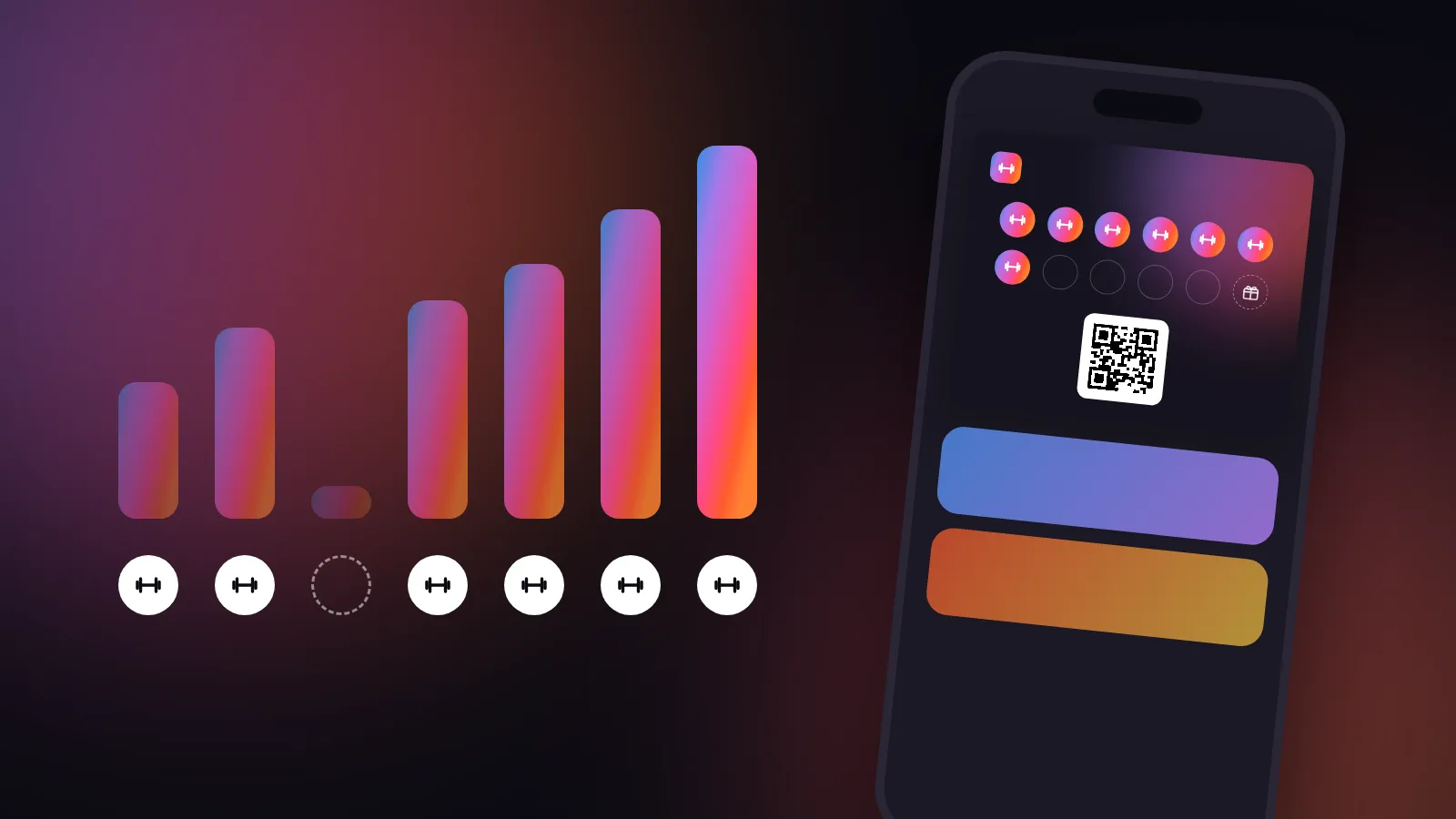
A loyalty program for a gym or fitness studio should reward visits, not payments: the membership is already paid, and what you need is the new member walking in again in week three. The setup that fits is a stamp card for the first six weeks (two visits a week, twelve stamps), a reward that costs you an empty spot rather than money, and one message with a free stamp for anyone who goes quiet. Have it ready before Monday 4 January.
January fills the changing rooms, and by late February the new faces are fewer. What surprised me in this morning's research is how small the thing is that brings people back. In a study of more than 60,000 gym members run by Wharton researchers with a US gym chain, one of the best of 53 programmes gave a bonus worth about nine cents to members who came back after a missed workout. It raised weekly visits by 27% during the four weeks it ran. Nine cents. The lead researcher's explanation was that it stops one missed session from turning into a run of them.
Count visits, because the membership is already paid
Most gym loyalty ideas reward money: renew for a year, get a month free. That is a pricing decision, and it speaks to people who are staying anyway. The people you lose in February are not thinking about renewals. They are quietly deciding whether they are someone who goes to the gym.
That decision takes time. Researchers at UCL found it took 66 days on average for a new daily behaviour to become automatic, and that missing a single day did not ruin it, while being very inconsistent did. Six weeks of visits won't finish the job, but it carries a new member through the stretch where most people drift. So the card counts the one thing that matters in those weeks: did they come in.
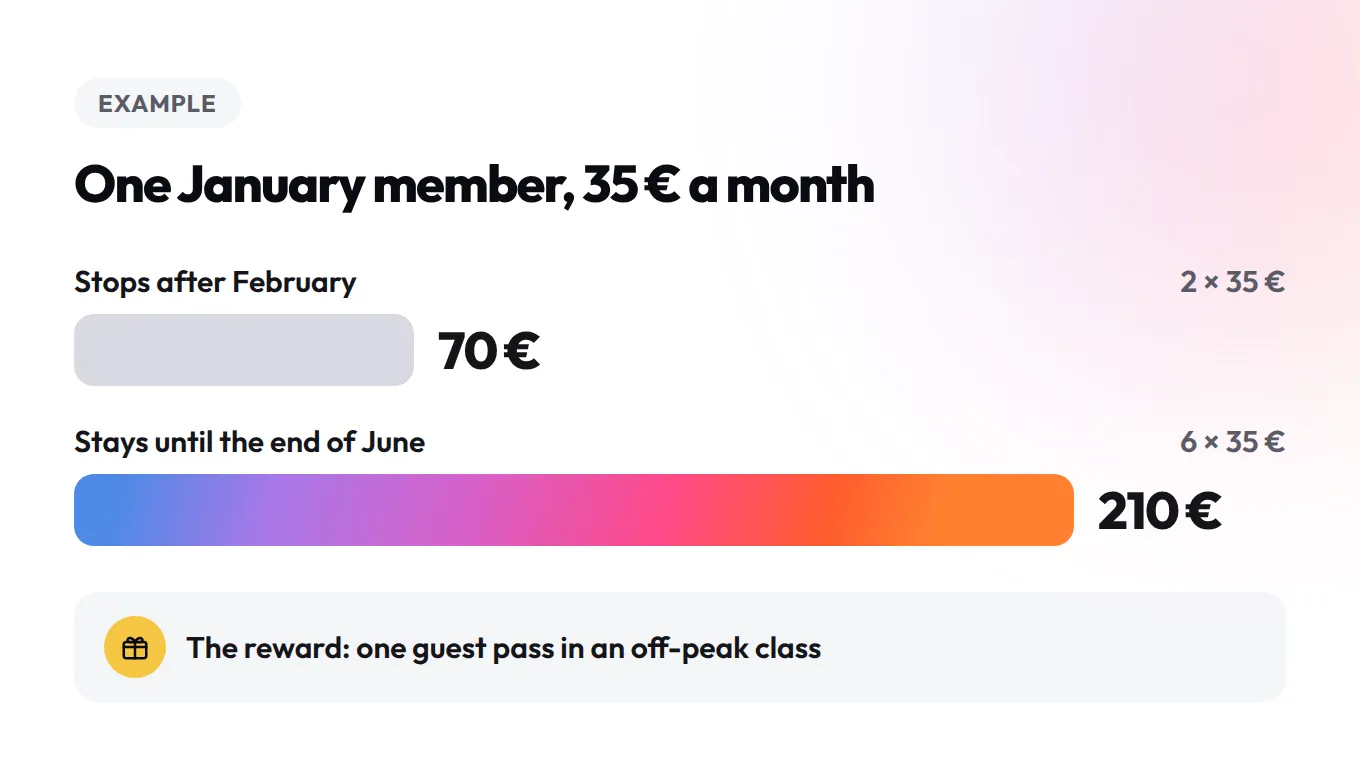
Those weeks are also worth real money. In example numbers, with a 35 € monthly membership: a January member who stops after February brings you 70 €, one who stays until the end of June brings 210 €.
The card: twelve stamps in six weeks
Here is the setup I'd copy:
- One stamp per visit, at most one a day, so nobody trains twice in an afternoon to fill the card.
- Twelve stamps, which is two visits a week for six weeks. Three a week looks better on paper, but a card that feels out of reach by week two gets ignored.
- New members get the card at sign-up, existing members whenever they ask at the desk.
- It does not expire after six weeks. The six weeks is simply how long the first card should take, not a deadline.
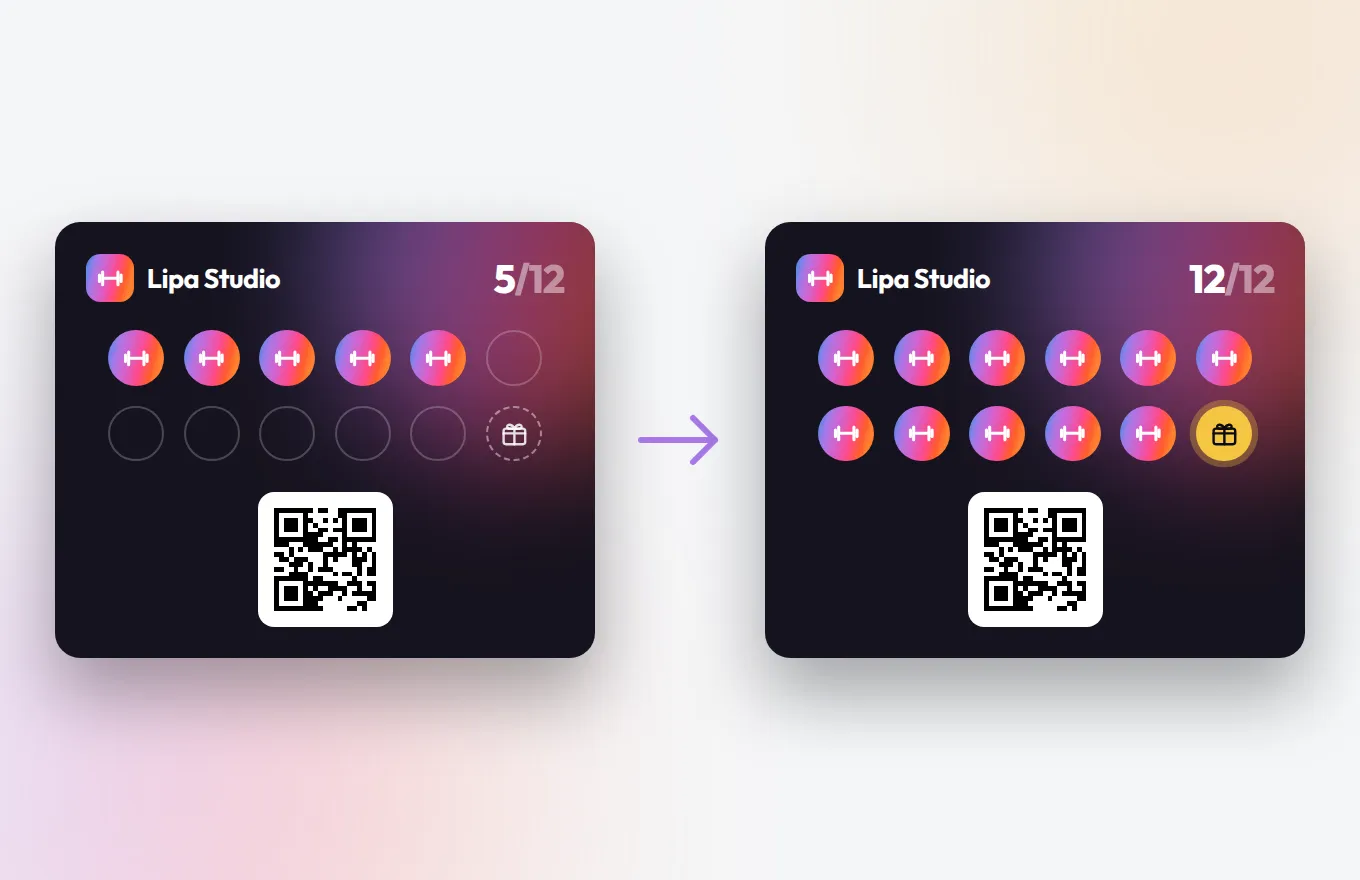
It works as a stamp card in Apple Wallet or Google Wallet: the member scans the QR poster at reception, confirms their email and adds the card to their phone, with no app to install. At the desk, staff scan the card on any phone and tap once. If you sell drinks or kit through a till we connect to (Square, Lightspeed, SumUp, Toast, Clover, Zettle or Shopify POS), that connection comes with the Growth plan, but for visits the scan at the desk is the simplest way. We don't plug into door or booking systems out of the box, so if your entry runs through one, keep the scan. Studios that sell ten-class packs can also put the pack itself on a prepaid bundle card that counts down with every class.
The reward: a guest pass, not a protein bar
My pick for the twelfth stamp is a free guest pass: the member brings a friend for one session. It costs you a place in an off-peak class, or a visit to a gym floor that is half empty at 14:00 anyway, and it does two jobs. Your new member trains with someone, which makes the next visit more likely, and the friend sees your place from the inside. A free shake or a branded towel costs real money and does only the first job.
If your classes are small, make the guest pass valid off-peak only, so the 18:00 class doesn't fill with guests. If you'd rather give something physical, the stamp card maths shows how to work out what a reward really costs before you promise it.
The comeback stamp
This is the Wharton finding, translated for a gym desk. When a new member hasn't been in for ten days, a short push message appears on their card, with a reason to come back this week:
"Haven't seen you for a bit, Marta. A free stamp is waiting on your card. See you this week?"
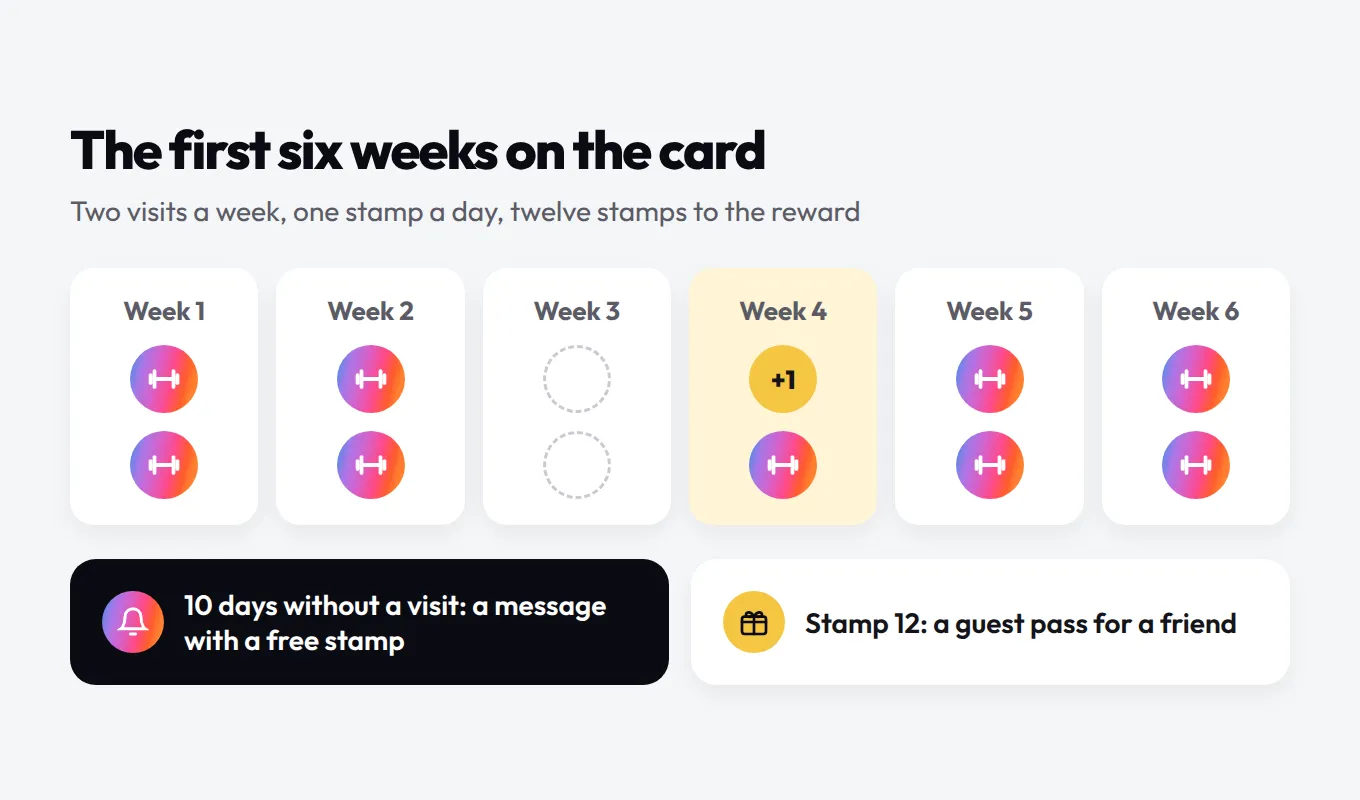
Set it up once as a win-back automation and it goes out on its own; the Starter plan includes two automations, so this one and a birthday treat fit. Two rules for the wording: no guilt ("You've missed 3 sessions") and no fitness lecture. The message holds the door open; it doesn't weigh anyone.
Send it only to members who agreed to receive messages; each member chooses what they get, and you can see who agreed and when. The GDPR describes consent as freely given, specific, informed and unambiguous (Article 4, as of November 2026). What that means for your studio is a question for your adviser or your data protection authority, not for me. If you are curious how a message reaches a locked phone, the Wallet card explainer walks through it.
The weekly routine for January and February
| When | Who | What |
|---|---|---|
| Every visit | Desk | Scan the card on the way in, not on the way out, when people are in a hurry |
| Monday | Manager | Open the list of members who are slipping away and pick three for a personal hello from a trainer next time they come in |
| Wednesday | Trainers | Learn the names of three new members on the card |
| Friday | Manager | Count how many January cards passed six stamps this week, and tell the team |
| End of February | Owner | Of everyone who joined in January, count who still came in during the last two weeks of February |
The Friday number is the one I'd watch most closely. Six stamps means a member has made it halfway through the stretch where most people drift, and a team that hears that number every week starts asking about the card without being told. On the Growth plan, the "Did it work?" report also compares members who got the comeback message with a small held-back group, so you can see whether the message brought people in or they would have come anyway.
Ready before 4 January
- The card made: twelve stamps, one per day, a guest pass as the reward.
- The QR poster at reception at eye level, and a second one by the water fountain.
- A desk phone with the staff scan app, logged in and charged.
- One sentence for the sign-up desk: "Your membership gets you in, this card gets a friend in. Scan it and you're done."
- The comeback message written and set to ten days without a visit.
- One test: someone on the team joins, gets a stamp and sees it on their phone.
The Starter plan is 19 € a month per location, or 11.40 € a month for the first 12 months at the founding price, and there are 30 days free with no payment card (as of November 2026). Bundles and memberships come with Growth. If you run several clubs, try it in two first; the multi-location rollout plan has dates for this winter.
The member who is still here in March
I think gyms and studios spend too much of their energy on January sign-ups and too little on week three. A sign-up is a promise someone makes to themselves; the visits are whether they keep it. A twelve-stamp card and a free stamp after a quiet week won't make anyone fit, but they can make the second and third week a little easier to show up for. Which raises a question worth answering before January: how many of last year's January members are still coming in?
More stories
 Loyalty program for multiple locations: a rollout plan from pilot to every branch
One set of rules, a four-week pilot in two branches, no changes in December, then weekly waves: a dated rollout plan for chains of 5 to 100 shops.
 How much does a loyalty reward really cost? The stamp card maths
A free 10th coffee is not a 10% discount. Here is how to work out what a stamp card reward really costs you, and how to pick one that feels big.
 How a Wallet loyalty card works, from the QR poster to the lock screen
What happens between the QR poster, the till and the customer's lock screen, and the two places a Wallet loyalty card quietly goes wrong.