
How much does a loyalty reward really cost? The stamp card maths
 Oleksii Andriiuk
Founder
A "buy 9, get the 10th free" card looks like a 10% discount, but that is the shelf price talking. What a loyalty reward really costs you is the cost price of the free item, divided by everything the customer spent to earn it, and for a product reward that is far less than the shelf price suggests: 2% to 4% of their spend in the examples below. A euro discount or cashback is different: it costs exactly what it says. Here is how to work out your own number in five minutes, and how to pick a reward that feels big and costs little.
It is easy to set the reward the other way round: pick something that sounds generous, worry it is too expensive, then quietly make the card longer. While researching this post I read a thread on a till maker's community forum where a coffee shop owner described a different leak: customers bought the cheapest drip coffee to collect stamps, then cashed the card in on the most expensive drink on the menu. Both problems have the same fix, and it starts with two numbers you already know.
The only formula you need
Real cost of the reward ÷ what the customer spends to earn it = what the card costs you.
- Real cost is what the free item costs you to make or buy: ingredients, packaging, the flowers, the water and chemicals. Not the price on the board.
- What they spend to earn it is the number of stamps times your average visit.
The same sum works whether you run a stamp, points or cashback card; only the way you count the spend changes.
Take a bakery. The average visit is 6 €, the card needs 8 stamps, and the reward is a cinnamon bun that sells for 3.50 € and costs 1.10 € to bake (all example numbers). The customer spends 48 € to fill the card. At shelf price, the bun looks like 7.3% of that. At cost price, it is 2.3%.
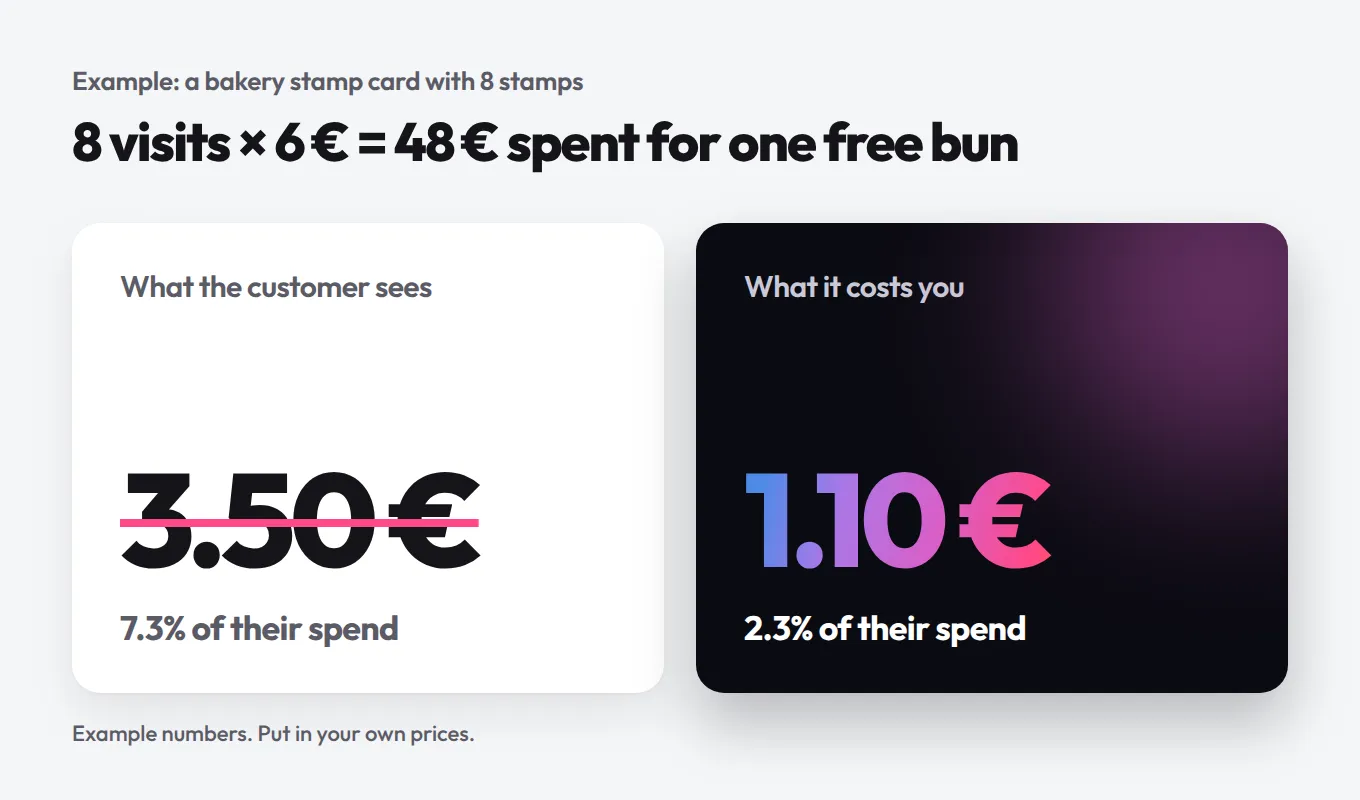
That gap is the whole point of a product reward. The customer values the bun at 3.50 €, because that is what they would have paid. You pay 1.10 €. A discount can never do that.
Free items and money off are not the same thing
Here is the same sum for three kinds of business, plus one that swaps the free item for money off. Put your own prices in; the pattern will hold.
| Bakery | Car wash | Florist, free bouquet | Florist, 10 € off | |
|---|---|---|---|---|
| Card | 8 stamps | 6 washes | 5 bouquets | 5 bouquets |
| Average visit | 6 € | 15 € | 35 € | 35 € |
| Spent to earn the reward | 48 € | 90 € | 175 € | 175 € |
| Reward at shelf price | 3.50 € (7.3%) | 12 € (13.3%) | 15 € (8.6%) | 10 € (5.7%) |
| Reward at cost price | 1.10 € (2.3%) | 3 € (3.3%) | 6 € (3.4%) | 10 € (5.7%) |
Look at the florist. The 10 € discount looks smaller than a 15 € bouquet, and it costs you two-thirds more. Money off, points worth euros and cashback cost you their full face value, every time. That is not a reason to avoid them (cashback suits a shop where the basket changes a lot, like a pet shop or a pharmacy), but compare them at cost price, not at the price on the label.
Where your cost is time rather than stock, the sum changes again. A free haircut takes a slot you could have sold, which is why the barber shop stamp card rewards a short add-on in quiet hours instead.
Check the reward against the calendar, not only the margin
A cheap reward that takes eight months to earn is not a reward. It is a piece of cardboard in a coat pocket. So the second check is time: how long does a typical regular need to fill the card?
- A bakery regular who comes twice a week fills 8 stamps in a month.
- A car wash customer who comes every three weeks needs about four months for 6 washes.
- Someone who buys flowers every two weeks fills a 5-bouquet card in about ten weeks.
My rule of thumb, not a law: a regular should reach the reward within two to three months. If they would need longer, shorten the card before you shrink the reward. If they get there in a fortnight, the card can be longer, or the reward a little bigger.
There is also good research on why short and visible works. In a study of a café reward programme, Ran Kivetz, Oleg Urminsky and Yuhuang Zheng found that customers on a "buy 10 coffees, get one free" card bought more often the closer they got to the free coffee. They also gave some customers a 12-stamp card with two stamps already filled in, and those customers finished their 10 purchases faster than people with an ordinary 10-stamp card (Journal of Marketing Research, 2006). Same number of coffees to buy, but the card that already looked started got finished sooner.
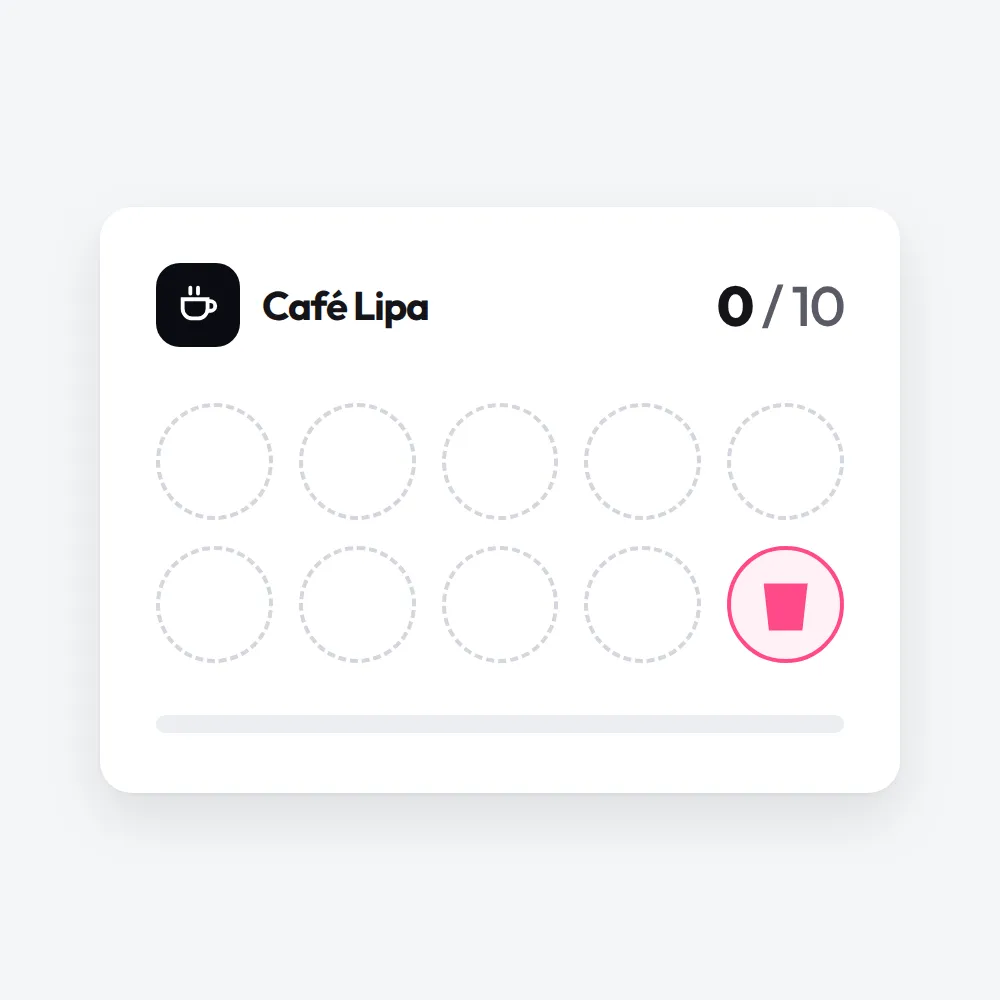
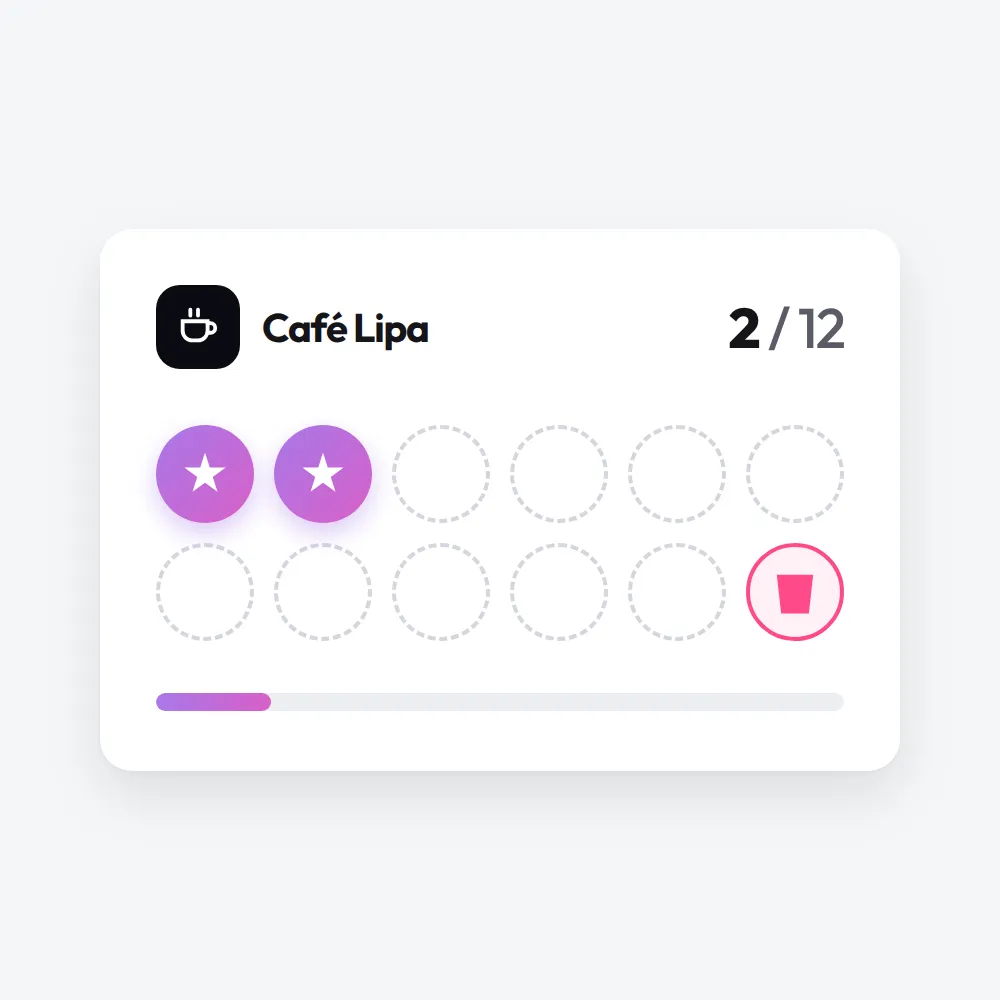
You can borrow that cheaply: give a bonus stamp when someone joins, so nobody starts at zero. It costs you a fraction of one reward, and only for the people who actually come back.
Close the gaming gap
Back to the forum owner and the cheap coffee. A reward written as "any drink" lets the cost float up to your most expensive item, while the stamps come in at your cheapest. Two small rules fix it:
- Name the reward, or cap it. "A cinnamon bun" or "any hot drink up to 4 €", not "anything from the counter".
- Set a minimum spend per stamp if your prices vary a lot, so a 1 € purchase and a 30 € purchase don't earn the same.
In Loyalius you name the reward when you create the card, and with a till connection the stamps come from the receipt rather than from someone remembering them in the Saturday queue.
Don't count on unfinished cards
Not every card gets finished. Some customers move away, some lose interest at stamp 3. That makes your programme cheaper overall than the table above, and it is tempting to set a bigger reward on the assumption that half the cards will never be redeemed.
I wouldn't. The people who finish their cards are your regulars, the exact people the card is for. Price the reward as if every card gets finished; anything left unredeemed is a margin of safety, not a budget. (It is the same reason I'd rather not lean on unspent gift cards either.)
Where I'd set it
If you want a starting point to argue with: a product reward your customers already like, with a real cost of 2% to 4% of what they spend to earn it, reachable in two to three months, with a bonus stamp at the start. For most bakeries, cafés, car washes and flower shops that is something on your menu or shelf today, not a discount.
Then watch one thing for the first two months: how many cards reach the reward. If almost nobody gets there, the card is too long. If everyone does and your margin feels it, raise the stamps by one rather than cheapening the reward. You can test both on a 30-day trial without a payment card, but the sum itself needs only a pen and last week's receipts.
More stories
 How a Wallet loyalty card works, from the QR poster to the lock screen
What happens between the QR poster, the till and the customer's lock screen, and the two places a Wallet loyalty card quietly goes wrong.
 Gift cards for small business: 7 mistakes to fix before Christmas
Paper vouchers nobody can track, odd amounts, risky expiry dates and a forgotten recipient: seven gift card mistakes and what to do instead.
 Loyalty program for a barber shop: a stamp card built for the haircut cycle
A six-stamp card, a reward for quiet hours and one message for the customer who went quiet: a barber shop loyalty setup you can copy.