
Should you close your restaurant on slow days? Do this sum first
 Oleksii Andriiuk
Founder
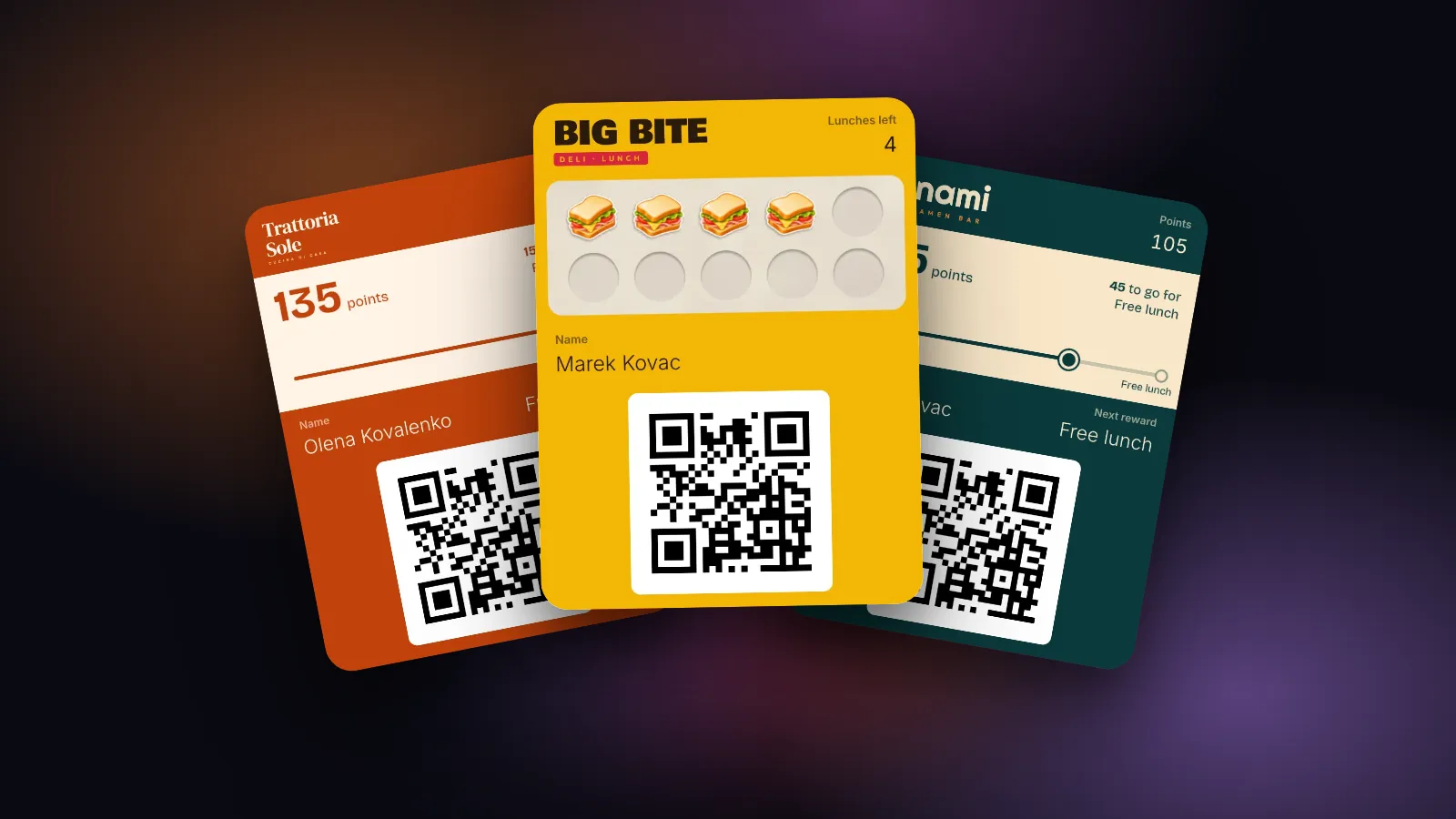
Should you close your restaurant on slow days? Only if the day loses money once you count what really goes away when you shut the door: food, staff hours, energy and card fees, but not the rent. Work out that one number for your quietest day, then work out how many extra guests would beat closing. If that number is small, fill the day. If it is big, close it and enjoy the day off.
Most owners decide this from the feeling of standing in an empty dining room at 8 pm, and the feeling is often wrong both ways. Some keep a losing Monday open for years out of pride. Others close a day that was quietly paying the cook's wages. The sum takes ten minutes.
Why restaurants are quiet on weekdays now
Restaurants are quiet early in the week because guests spend more carefully and save eating out for the weekend. In the Czech Republic, restaurant owners told CNN Prima News in January 2026 that only Thursday to Saturday make a profit, weekday lunch visits had fallen by up to 8 % in a year, and one owner simply keeps his restaurant closed from Monday to Wednesday.
At the same time, every hour you are open costs more. Germany's minimum wage has been 13.90 € an hour since January 2026 and rises to 14.60 € in January 2027 (as of November 2026). Menu prices are climbing too: restaurant and café prices in the euro area were 3.6 % higher in October 2026 than a year before, according to Eurostat (as of November 2026).
Close the day or fill it: the sum that decides
Most advice on slow days skips the one thing that decides it: closing a day saves only the costs that stop when the door is shut. Rent, loan repayments, insurance and the coffee machine lease carry on whether you open on Monday or not. So the question is not "does Monday cover its share of the rent?" It is "does Monday bring in more than it costs to open?"
You need four numbers for your quietest day, an average from the last eight weeks:
- Sales on that day, without VAT.
- Food and drink cost, as a share of sales (your usual percentage is fine).
- Staff hours you would not pay if you closed, times what an hour really costs you, employer contributions included.
- Other day costs: energy for the kitchen, card fees, laundry.
Sales minus those three costs is what the day earns. Then ask one more question: if you closed, how many of those guests would simply come on another day instead? Regulars often do. Their visit moves to a day when your staff are already there, so you keep most of that margin without the Monday wages.
A worked example: one bistro, one quiet Monday
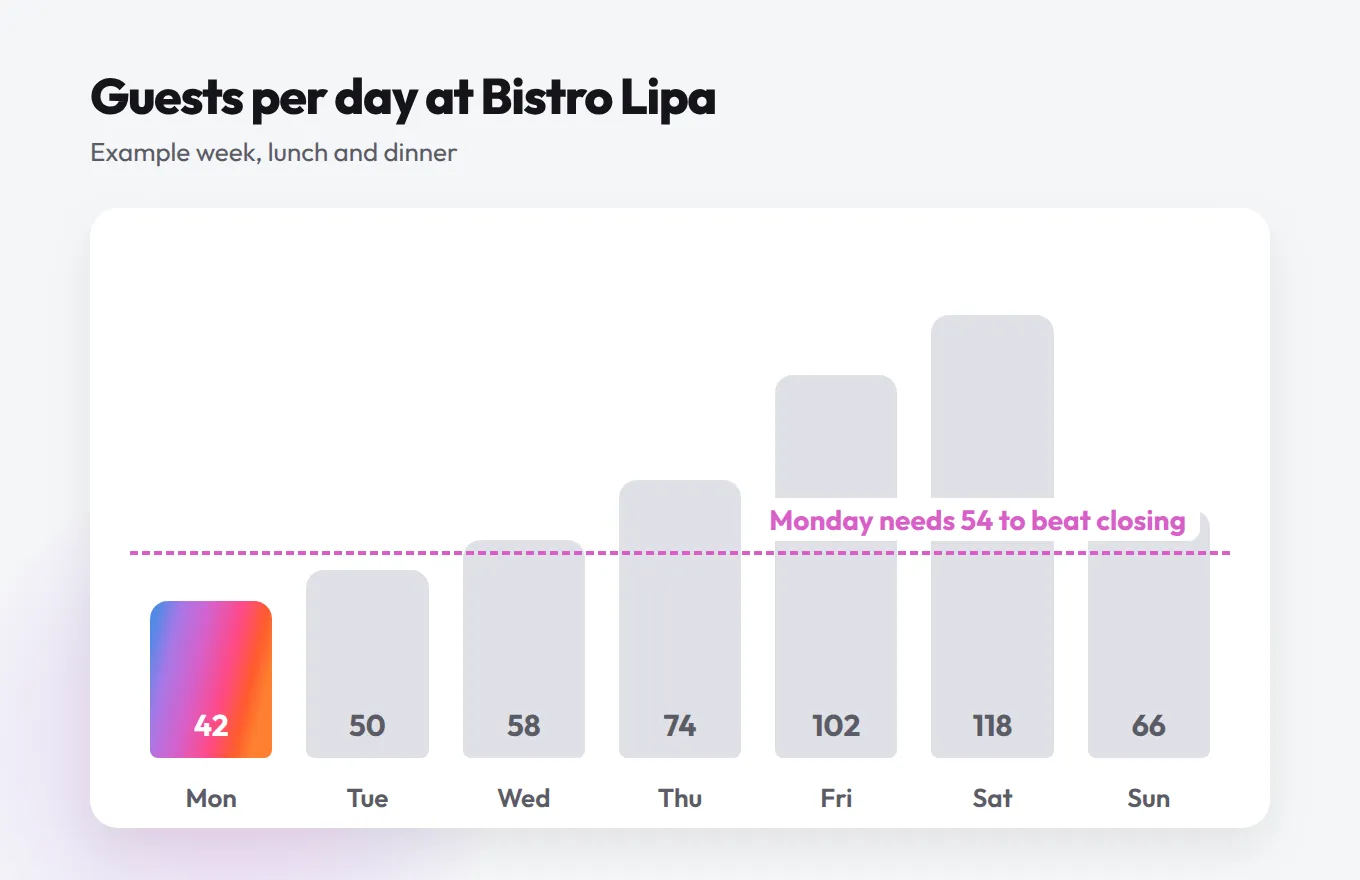
Take a bistro on a side street in a mid-sized town, call it Bistro Lipa, open seven days for lunch and dinner. These are example numbers, so put yours in their place. On a typical Monday it serves 42 guests who spend 19 € each, without VAT. Food and drink cost 30 % of sales. Three people work a 9 to 10 hour day, 28 hours in total, at about 17 € an hour once employer costs are added.
| Monday at Bistro Lipa (example) | Amount |
|---|---|
| Sales: 42 guests × 19 € | 798 € |
| Food and drink, 30 % | −239 € |
| Staff: 28 hours × 17 € | −476 € |
| Energy, card fees, laundry | −55 € |
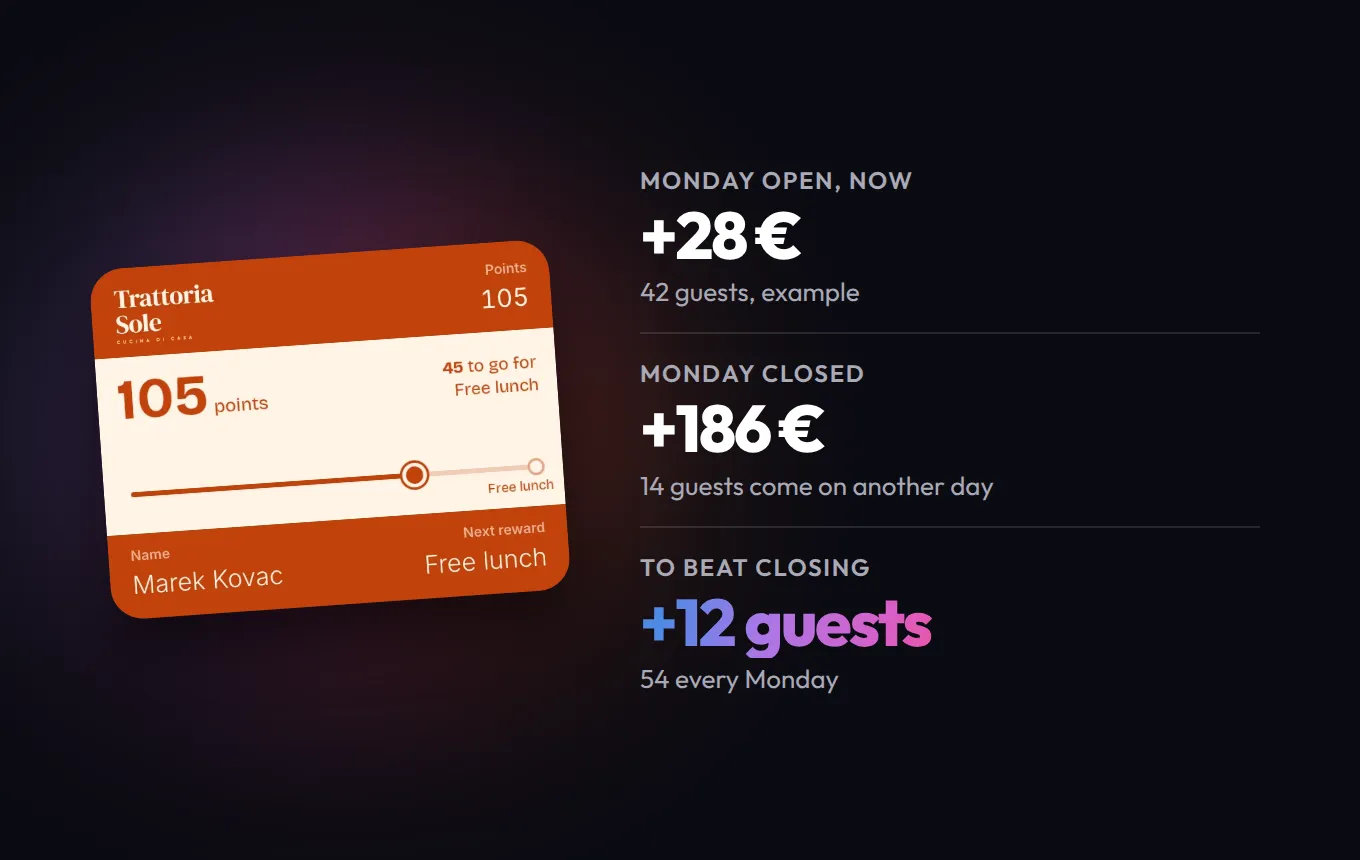
| What Monday earns | 28 € |
Now close it. Suppose a third of the Monday guests, 14 people, come on another day instead. Each of them leaves 19 € minus 30 % food cost, so 13.30 €, and you pay no extra wages for them on a Thursday. That is 186 € a week. Closing beats the current Monday by 158 € a week, about 680 € a month, plus a day off for you and your cook.
But look at it from the other side. Every extra guest on an open Monday also adds about 13.30 €, because the staff are paid anyway. To match what closing gives you, the bistro needs 158 € divided by 13.30 €, which is 12 more guests every Monday: 54 instead of 42. That is the line. Above it, stay open and fill the day. Clearly below it after a fair try, close.
Two things move the line in your favour without a single new guest. Shorter hours (open Monday for dinner only) cut the staff cost, and a shorter Monday menu cuts both prep time and waste. Try those first: they can turn a 28 € day into one worth keeping.
How to fill a slow day in a restaurant
If your line is a dozen guests or so, it is worth a real try. A quiet day fills far more easily from people who already know you than from strangers, so start there.
- Give the day a job. "We are open on Monday" is not a reason to come. A dish that only exists on Monday, a fixed price two-course dinner or the chef's experiment of the week is. Keep it the same every week so people can plan around it.
- Move the regulars, not the price. A guest who eats with you on Thursday and Saturday might come on Monday as well if something small rewards it. With a points card, double points on the quiet day does that without touching the menu price. A discount for everyone mostly pays people who were coming anyway.
- Sell lunch in advance. Ten lunches paid upfront give office regulars a reason to come back every weekday, and you have the money before the first plate. A prepaid lunch bundle on a Wallet card counts down what is left.
- Remind people on the morning of the day. One short message at 10 am on the quiet day ("Monday goulash is on, kitchen open from 12") works better than a newsletter nobody opens. Send it to people who agreed to hear from you, and only on that day.
- Invite the people who are free that night. Monday is when many other restaurants close, so it is the evening cooks and waiters eat out. Clubs, choirs and small groups also look for a room with no crowd. Tell them they are welcome, and keep a table ready.

This is where we come in, if you want it. Loyalius, a loyalty platform that puts stamp, points and cashback cards in Apple Wallet and Google Wallet, runs the points card, the lunch bundle and the morning message next to the till you already have; our restaurant page shows how that card looks for a dining room. Double points on one day is an earning boost, which comes with the Pro plan as of November 2026 (see pricing). Be honest with yourself about what it does, though: it brings the guests you already have back more often and on the day you choose. It will not make strangers find your street. For that you still need the sign, the window and an up-to-date listing on the map.
Give it eight weeks, then decide
One quiet Monday proves nothing: weather, a football match or a bank holiday can halve or double it. Run the new Monday for eight weeks, count guests every week and compare the average with your line. If you use a loyalty card, check how many of the extra guests were cardholders, which tells you whether it was the regulars who moved. I wrote down four numbers and one fair test for exactly this kind of check.
If after eight weeks you are far below the line, close the day without guilt.
Restaurant owners ask
Which day of the week is slowest for restaurants?
For many restaurants it is Monday or Tuesday. In the Czech Republic, the restaurant trade describes Monday to Wednesday and Sunday as the hard days, with the profit made from Thursday to Saturday. Your own till history is the only answer that counts, so look at the last eight weeks before you trust anyone's rule of thumb.
Do discounts on slow days bring in new customers?
Mostly they reward guests who would have come anyway, and they teach regulars to wait for the cheap day. A reason to come (a dish, an event, extra points for regulars) usually brings more people for less money. If you do discount, make it small, limited to the quiet day and measured against your line.
How do I tell regulars we are closing on Mondays?
Tell them in person and put a note on the door two weeks before the change. Say which day you would like them to come instead and why, for example that the kitchen wants one day to prepare the week. Regulars take a day off much better when they hear it from you than when they find the door locked.
Write your line on the rota
Tonight, take the last eight weeks from your till, fill in the four numbers for your quietest day and work out your line. Write it on the rota where everyone sees it: "Monday needs 54." Then you are no longer arguing with an empty dining room. You are counting towards a number. If you already run a points card, my weekly routine for restaurants fits neatly around a Monday like this.
More stories
 Regular customers stopped coming? How to spot it early and win them back
Lost regulars rarely leave in anger. How to see who has gone quiet, why they drift away, and how to bring them back with one small reason and a date.
 How to get staff to upsell when they hate sounding pushy
Staff never recommend anything? Give them one product, one sentence and one moment at the till each week, then count. A bakery example with the sums.
 How to get more clients as a nail tech when your book still has gaps
One nail tech's week is filled by about 60 regulars, not thousands of followers. Here is the sum, and five steps to find and keep them.