
How to get more clients as a nail tech when your book still has gaps
 Oleksii Andriiuk
Founder
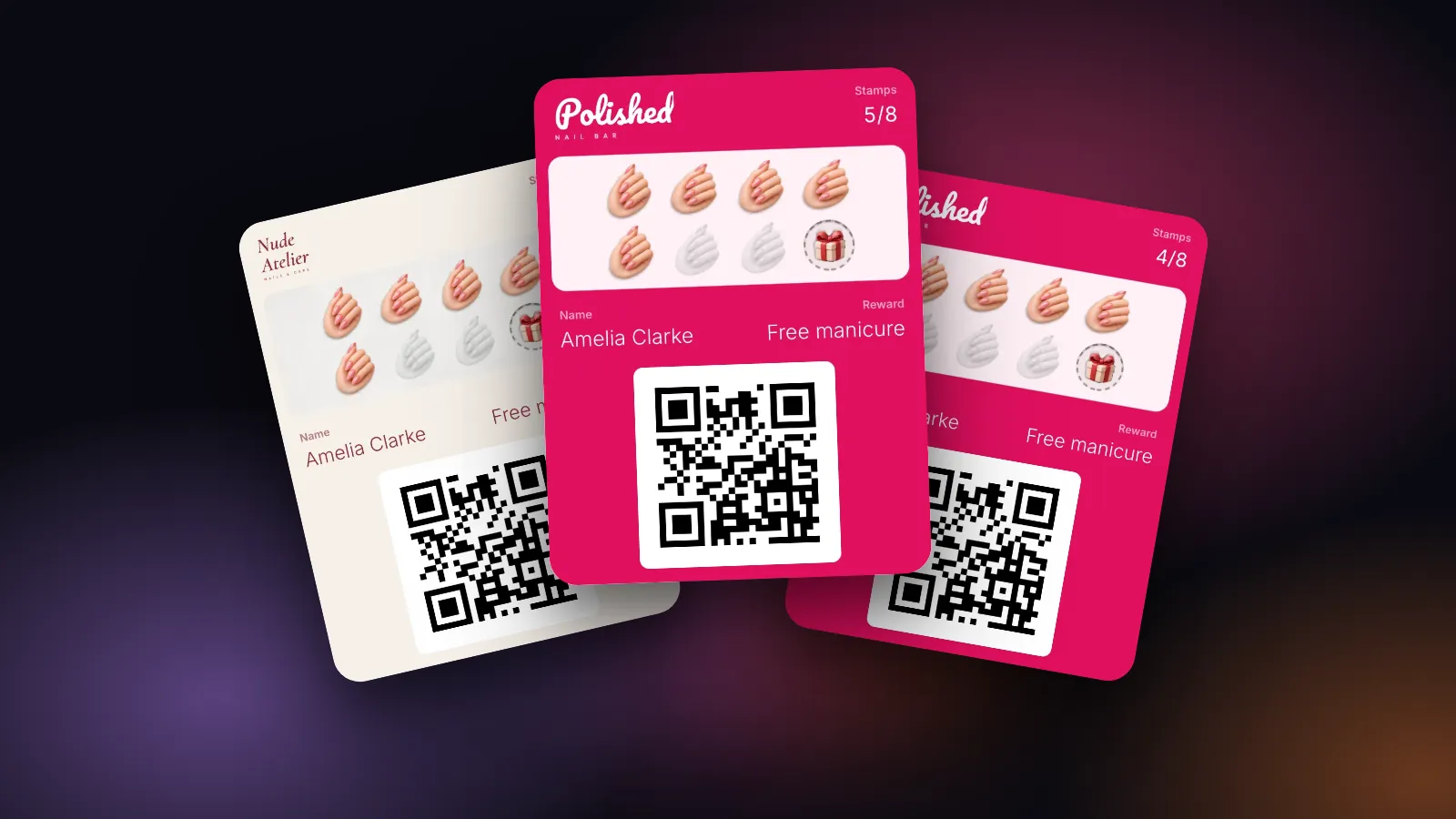
To get more clients as a nail tech, start by working out how many you actually need: one full-time nail tech on a three-week refill cycle is fully booked with about 60 regulars. That changes the job. Instead of chasing hundreds of strangers, you need a steady trickle of new faces, a first visit that turns into a second one, and regulars who come back on week three instead of week five.
Most advice for nail techs is a long list of marketing ideas: post more reels, run a giveaway, try a deal site. Some of it works. But the list never tells you when you are done, so you keep spending evenings on content while the gaps in Thursday's calendar stay where they are. I would rather start with a number and work backwards from it.
How many clients does a nail tech need?
A nail tech who does four appointments a day, five days a week, has 20 slots to fill. If each regular comes for a refill every three weeks, every regular fills one slot in three weeks, so 20 slots need 60 regulars. Put your own numbers in: slots per week multiplied by weeks between visits gives the regulars you need.
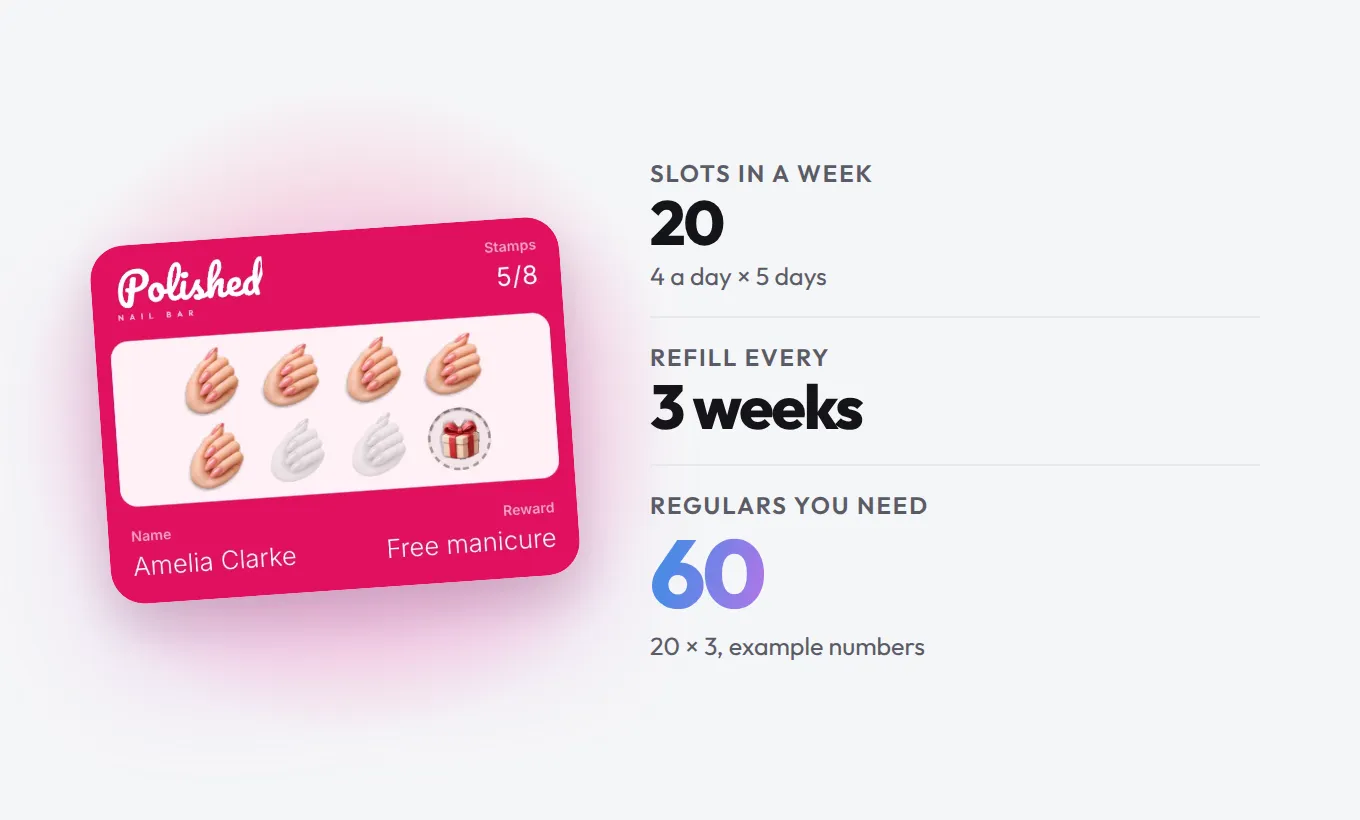
Two things fall out of this sum. First, 60 is a small number. It is one busy street's worth of people, not an audience. Second, the gap between visits matters as much as the number of clients. The same 60 clients coming every four weeks fill only 15 slots, and you are suddenly "short of clients" without having lost anyone. That steady refill rhythm is also why a stamp per appointment suits nail and lash studios so well.
A worked example: one nail tech, 20 slots a week
Take a one-chair studio on a side street, call it Studio Nela, open Tuesday to Saturday. The owner does four appointments a day, and a gel refill costs 38 €. These are example numbers, in the range many studios in Germany and Poland charge for a refill. Today she has 40 regulars who drift back roughly every four weeks, and about two first-time clients a week, half of whom come back.
Here is what twelve weeks of the steps below could do, if she gets her regulars rebooking at the chair and keeps half of her new clients:
| Today | After 12 weeks | |
|---|---|---|
| Regular clients | 40 | 52 |
| Weeks between visits | 4 | 3.5 |
| Regular appointments a week | 10 | 15 |
| First visits a week | 2 | 2 |
| Booked, out of 20 slots | 12 | 17 |
| Takings a week at 38 € | 456 € | 646 € |
That is 190 € more a week, or about 9,100 € over 48 working weeks, and she did not need a single extra first-time client to get there. The gain comes from two places: twelve first-time clients who stayed instead of drifting off, and existing regulars coming back half a week sooner. Neither costs anything in advertising.
How to get more clients as a nail tech, in five steps
1. Book the next fill before she leaves the chair
The cheapest new appointment you will ever get is the one booked while the client is still admiring her nails. Do not ask "would you like to book again?" Ask "shall I put you in for the same time in three weeks?" and have the calendar open. Then send one reminder a few days before the date, and one the day after a missed rebooking.
2. Make your Google listing your shop window
People looking for a new nail tech search on their phone, close to home or work, and decide from photos. Your free Google Business Profile should show your real opening hours, a booking link or phone number that someone answers, and photos of your own recent work, updated every few weeks. Ask happy regulars for a review at the moment they say they love the colour, not by email a week later.
3. Give every regular one reason to send a friend
A personal recommendation still brings the clients most likely to stay, because they arrive already trusting you. Make it easy: a small card with your name and booking link for the regular to hand on, and a thank-you for her when the friend books (a free nail art upgrade on her next visit costs you a few minutes, not a discount on the whole service).
4. Find the neighbours who share your clients
Hairdressers, lash and brow artists, bridal shops and the café across the road see the same people you want. Swap a small stack of cards, or offer their staff one discounted set so they wear your work. One good partner who sends you two clients a month is worth more than a week of posting.
5. Turn the first visit into the second
A first-time client who has not booked again within three or four weeks has usually just forgotten, or found someone closer. This is where a loyalty card earns its place: a stamp for every appointment, and a reward she can see getting closer. Loyalius is a loyalty platform that puts stamp, points and cashback cards in Apple Wallet and Google Wallet, so the card sits on her phone next to her bank card, and a "Time for a fill?" message can land on her lock screen three weeks after her last set. Here is what a digital stamp card for a nail studio looks like, in two designs:
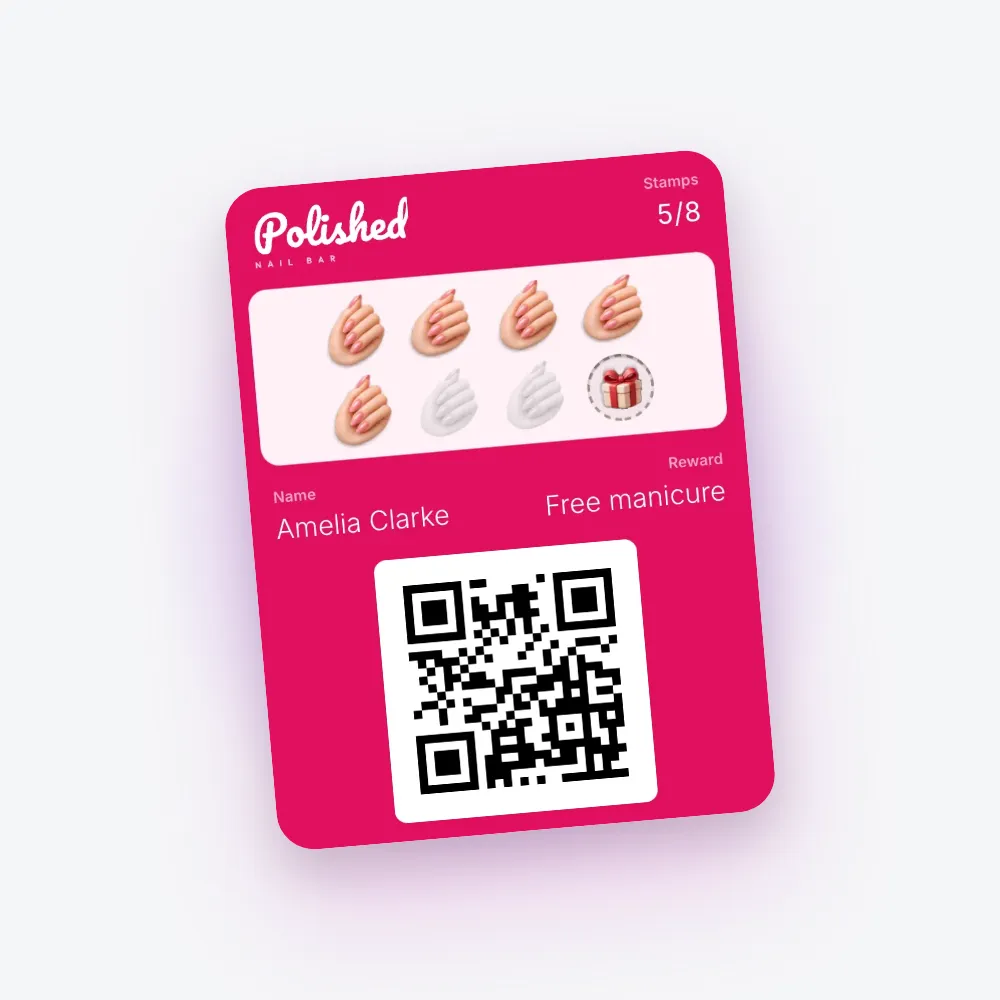
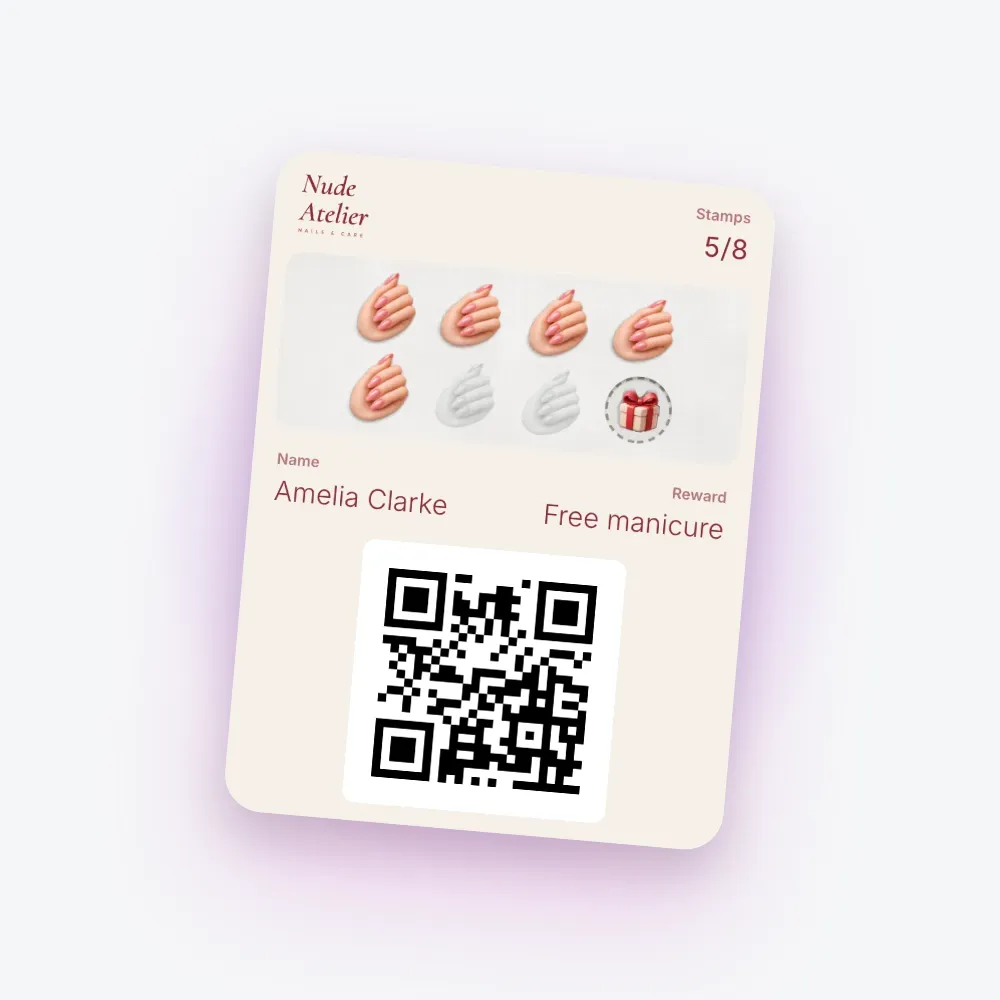
The card does not find strangers for you. It works on the people who have already sat in your chair, which is exactly where the worked example found most of its 190 €. I wrote more about winning the second visit within two weeks, and the steps there apply to a nail studio just as well as to a café.
Why price cuts rarely fill a nail tech's book
More studios are competing for the same hands. In Baden-Württemberg alone, the number of registered cosmetics businesses grew by 4.9% in 2025 to 11,721, while hairdressers shrank slightly (HANDWERK BW, Betriebsstatistik 2025, February 2026). In Poland, 14,700 new beauty businesses were registered in 2024 against just over 5,000 closures, according to Dun & Bradstreet data reported by Rzeczpospolita on 27 January 2025.
When a new studio opens with lower prices, cutting yours feels like the obvious answer. I think it is usually the wrong one. Prices for personal grooming treatments across the EU were 3.5% higher in September 2026 than a year earlier (Eurostat, HICP by product, as of November 2026), so your materials and rent are moving the same way. A client who leaves over two euros was rarely a regular, and a deal-site voucher mostly brings people who will chase the next voucher. If a rival has just opened near you, I made the case for holding your prices for eight weeks and protecting your regulars first.
Nail techs also ask
How long does it take to build a full client list as a nail tech?
For most nail techs starting from zero, filling a book takes many months rather than weeks, because each new client needs two or three visits before she becomes a regular. With about two first visits a week and half of them staying, you add roughly four regulars a month, so going from 20 to 60 takes close to a year. Rebooking at the chair is the fastest way to shorten that.
Should I offer a discount to new nail clients?
A small first-visit offer is fine if it is tied to the second visit, for example a discount that applies when she books her refill. A big discount on the first set alone attracts people who are shopping for a price, and they rarely come back at the full one.
Is Instagram or Google better for getting nail clients?
They do different jobs. Instagram shows your style to people who may book one day, while Google Maps catches people who want a nail tech near them this week. If you only have time for one, keep your Google listing current first, because those searchers are already ready to book.
Count your sixty
Tonight, open your calendar for the last eight weeks and write down every client who came more than once. Divide your weekly slots by that number of regulars and you will see whether your problem is too few people or people coming back too slowly. My bet is that for most studios it is the second, and that one is fixed at the chair, not on Instagram.
More stories
 Regular customers stopped coming? How to spot it early and win them back
Lost regulars rarely leave in anger. How to see who has gone quiet, why they drift away, and how to bring them back with one small reason and a date.
 Should you close your restaurant on slow days? Do this sum first
Quiet Mondays? Work out what the day really earns, how many guests would beat closing it, and how to fill it if it is worth keeping. A bistro example.
 How to get staff to upsell when they hate sounding pushy
Staff never recommend anything? Give them one product, one sentence and one moment at the till each week, then count. A bakery example with the sums.