
Regular customers stopped coming? How to spot it early and win them back
 Oleksii Andriiuk
Founder
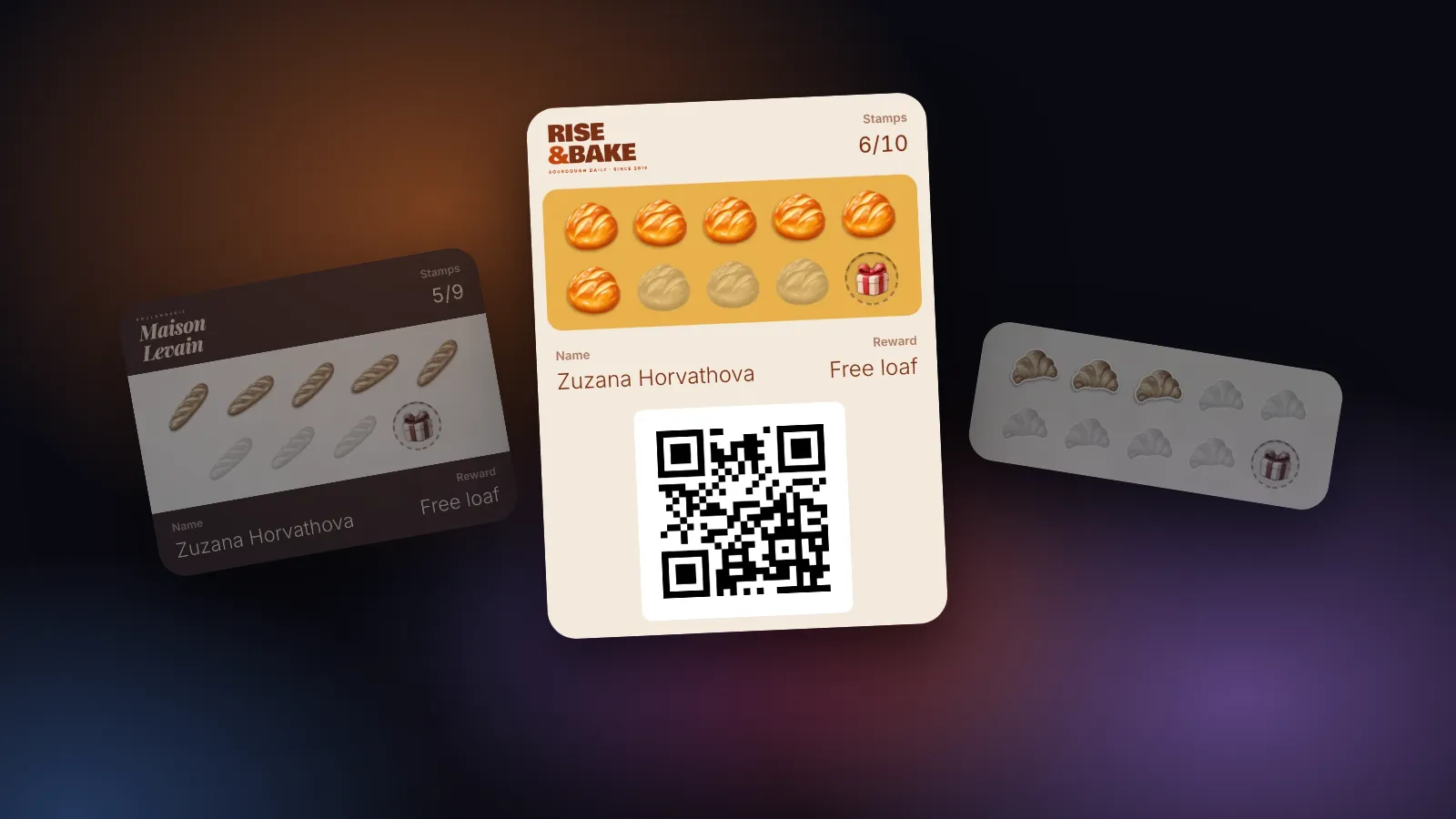
When regular customers stopped coming, most of them did not leave in anger. They changed their route, found something cheaper on the way, or simply stopped feeling noticed. The fix is to spot them early, while the habit is still warm: decide what "gone quiet" means for your shop, look at that list every week, talk to the ones you know, and give each of them one small reason to come back within two weeks.
Nobody quits a bakery in one day. The man who buys two rolls at ten past seven skips a Tuesday, then a whole week, and by the time someone behind the counter says "we haven't seen him in ages", he has a new habit at the supermarket on the station road. That is what makes lost regulars so expensive: there is no moment when they leave, so there is no moment when anyone reacts.
Bakeries feel this more than most. In Germany, craft bakeries sold 6 % less bread by volume in the first quarter of 2026 than a year earlier, while the self-service bake stations in supermarkets sold 6 % more, according to YouGov's shopper panel (July 2026). Of the people who prefer to buy bread at the supermarket, 74 % give the lower price as the main reason and 41 % like getting everything in one place. Among those who prefer a bakery, 84 % say quality. So the people drifting away mostly did not stop liking your bread. They stopped making the trip.
Why do regular customers stop coming?
Regular customers stop coming for four reasons, and only one of them is a complaint.
- Their life changed. A new job, a new route to school, a move across town. You cannot win these people back, and you should not spend much trying.
- Something cheaper or easier appeared on their way. A bake station in the supermarket, a new chain, an app that delivers. These people are winnable, but rarely by matching the price. They come back when the trip to you feels easy again.
- One bad visit. A long queue at 7:30, a burnt batch, a sharp word from a tired colleague. Winnable, if someone asks and listens.
- Nobody noticed them. A regular is already a customer, so nobody courts them any more. No greeting by name, no small thank you, no sign that anyone would miss them.
I would bet the fourth group is the biggest in most shops, and it is the cheapest to fix. The hard part is seeing who is in it.
How do you know a regular has stopped coming?
A regular has stopped coming when the gap since their last visit is about three times their usual gap. Twice the usual gap is a warning, three times means they have gone quiet. For a daily bakery customer that is about three weeks. For someone who buys a cake every Saturday it is about a month, and for a client who has her hair cut every five weeks it is around fifteen weeks.
That rule only works if you know who came. Most shops do not:
- Without any data, ask the team to write down twenty regular faces they know ("two rolls and a flat white, ten past seven") and tick them off for a fortnight. Crude, but it works.
- With till data only, you see products, not people. A drop in early-morning coffee-and-roll sales tells you something changed, not who left.
- With a named loyalty card, every visit has a name and a date, so the quiet list writes itself. That is the main thing a digital loyalty card for bakeries adds here: not the free loaf, but knowing that Zuzana has not been in for nineteen days.
A worked example: three bakery shops, one quiet list
Take a bakery with three shops in a mid-sized town, call it Kornfeld, open from 6:30 to 18:30, with a stamp card that 1,200 regulars use. "Regular" here means at least four visits in the previous eight weeks. At the start of November the owner pulls the list of regulars with no visit in the last three weeks. All numbers are example numbers, so put your own in.
| Shop | Regulars | Gone quiet | Share |
|---|---|---|---|
| Old Town | 420 | 25 | 6.0 % |
| Station | 380 | 58 | 15.3 % |
| South Ring | 400 | 23 | 5.8 % |
| All three | 1,200 | 106 | 8.8 % |
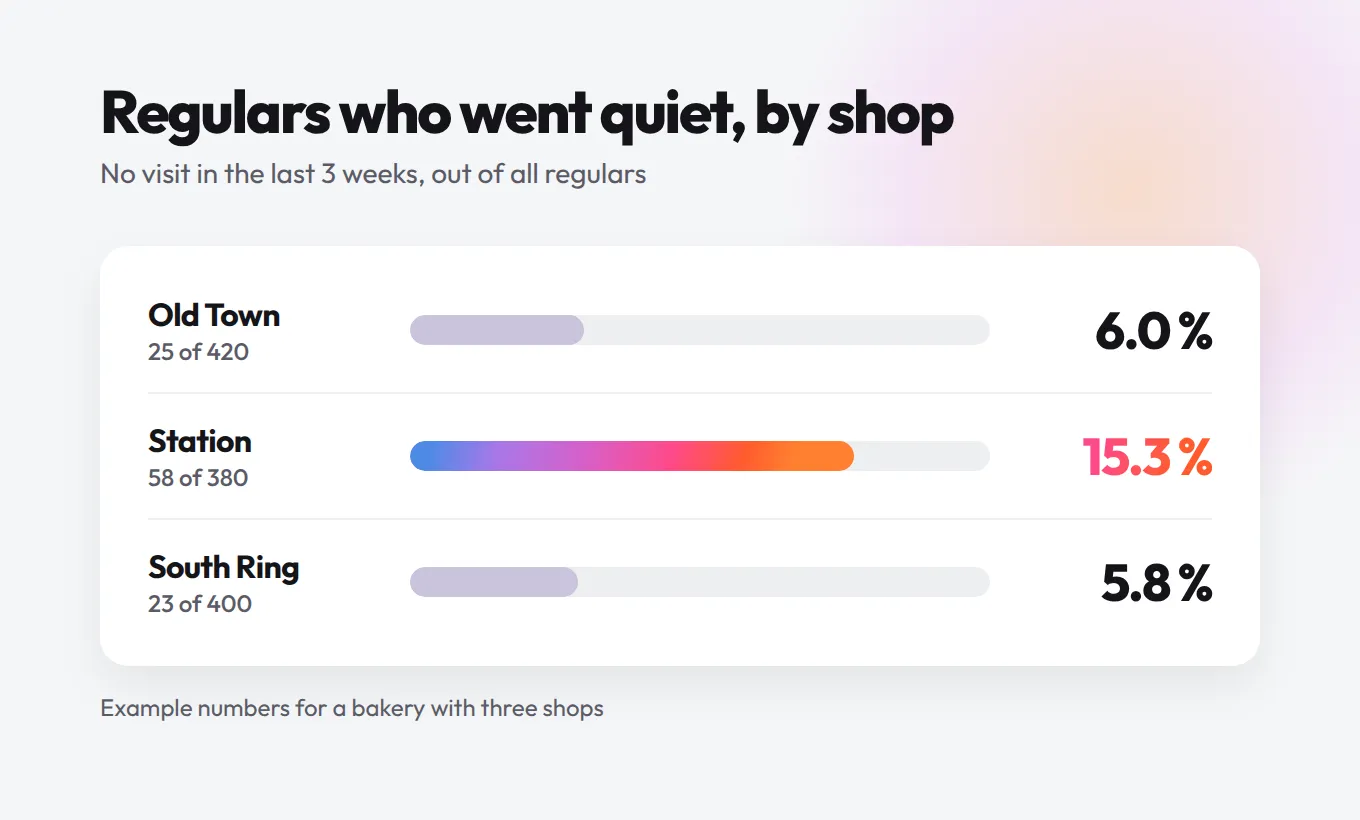
Before they went quiet, these 106 people spent on average 4.60 € a visit, four times a week: 18.40 € each per week. If none of them comes back, that is about 8,450 € of sales a month walking past the door (106 × 18.40 € × 4.33 weeks).
Now the win-back. 80 of the 106 have agreed to receive messages, so the owner sends them one, with a free croissant on their next visit until Sunday.
| What happens | Example |
|---|---|
| Messaged regulars | 80 |
| Back within 14 days | 16 (1 in 5) |
| Would have come back anyway | 8 (1 in 10) |
| Extra regulars the message won | 8 |
| Cost of 16 free croissants | 7.20 € (0.45 € each at cost) |
| Extra sales if the 8 stay six months | 3,827.20 € |
Two things in that table matter more than the totals. First, some people come back without any message, so count only the difference. The simplest check is to hold back a few names, message the rest, and compare. Second, look at the Station shop. Its share is more than twice the others, and no message fixes whatever happened there. Maybe a supermarket opened a bake station nearby, maybe the morning queue got longer after a staff change. In a chain, the quiet list per branch is the earliest warning you get, weeks before the monthly sales report. When one branch stands out, split its sales into three numbers before you change anything, and go and stand in that shop at 7:15 for a morning.
How to win back customers who stopped coming
- Ask the ones you recognise. When a quiet regular does walk in, the person at the counter says "Good to see you again, we missed you", and means it. If there was a bad visit, this is when you hear about it. Fix the cause and say thank you for being told.
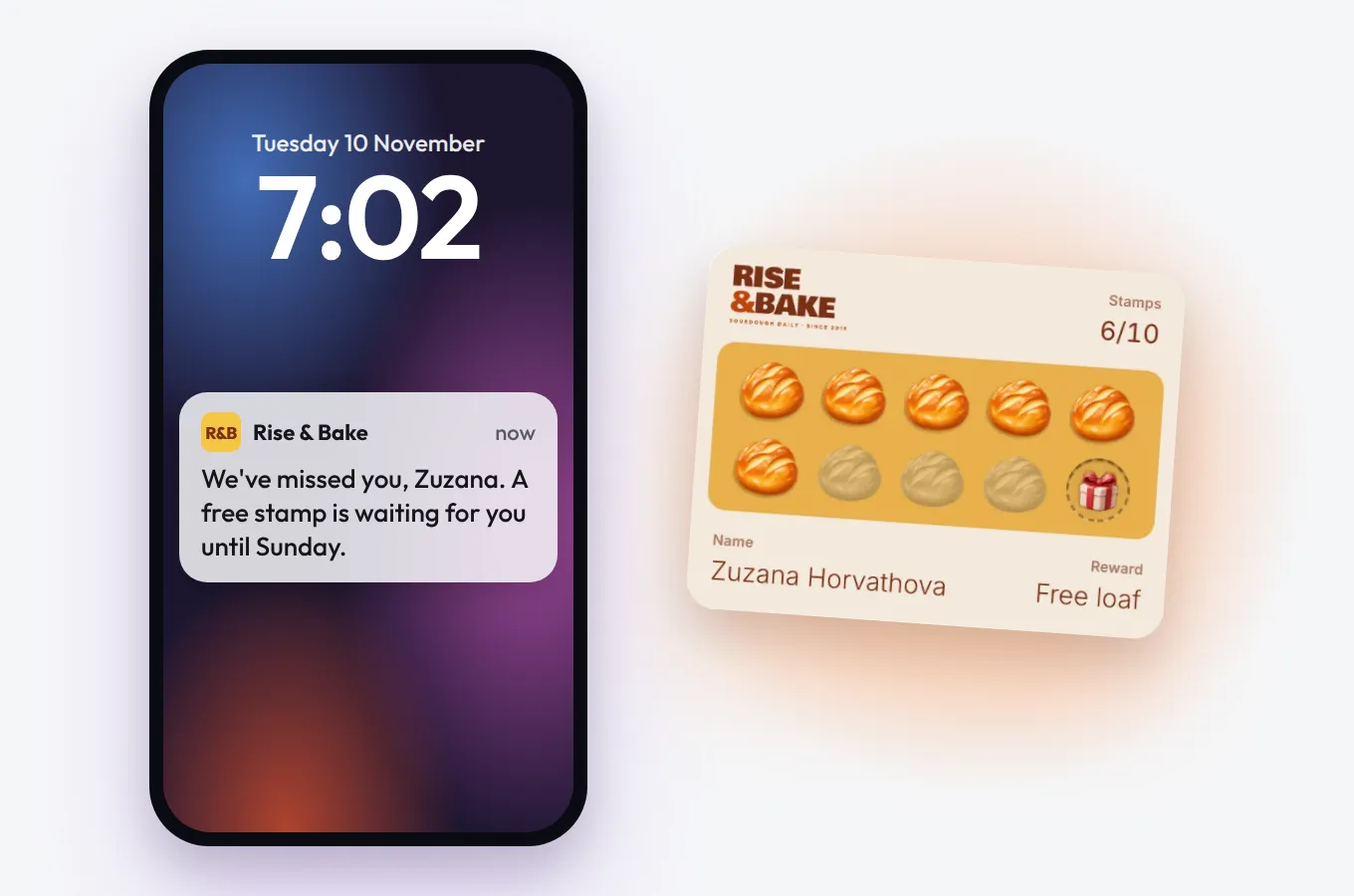
- Send one message with one small reason and a date. "Your croissant is waiting until Sunday" works better than "10 % off your next purchase": it is concrete, it costs you the price of flour and butter, and it has a deadline. Send it only to people who agreed to receive offers; our guide to consent for loyalty messages explains which messages need it.
- Remove the reason they drifted, where you can. If they left for convenience, the message alone will not hold them. A pre-order for the morning rush, a second person on the till from 7:00 to 8:00, or a card that works without fishing for paper will.
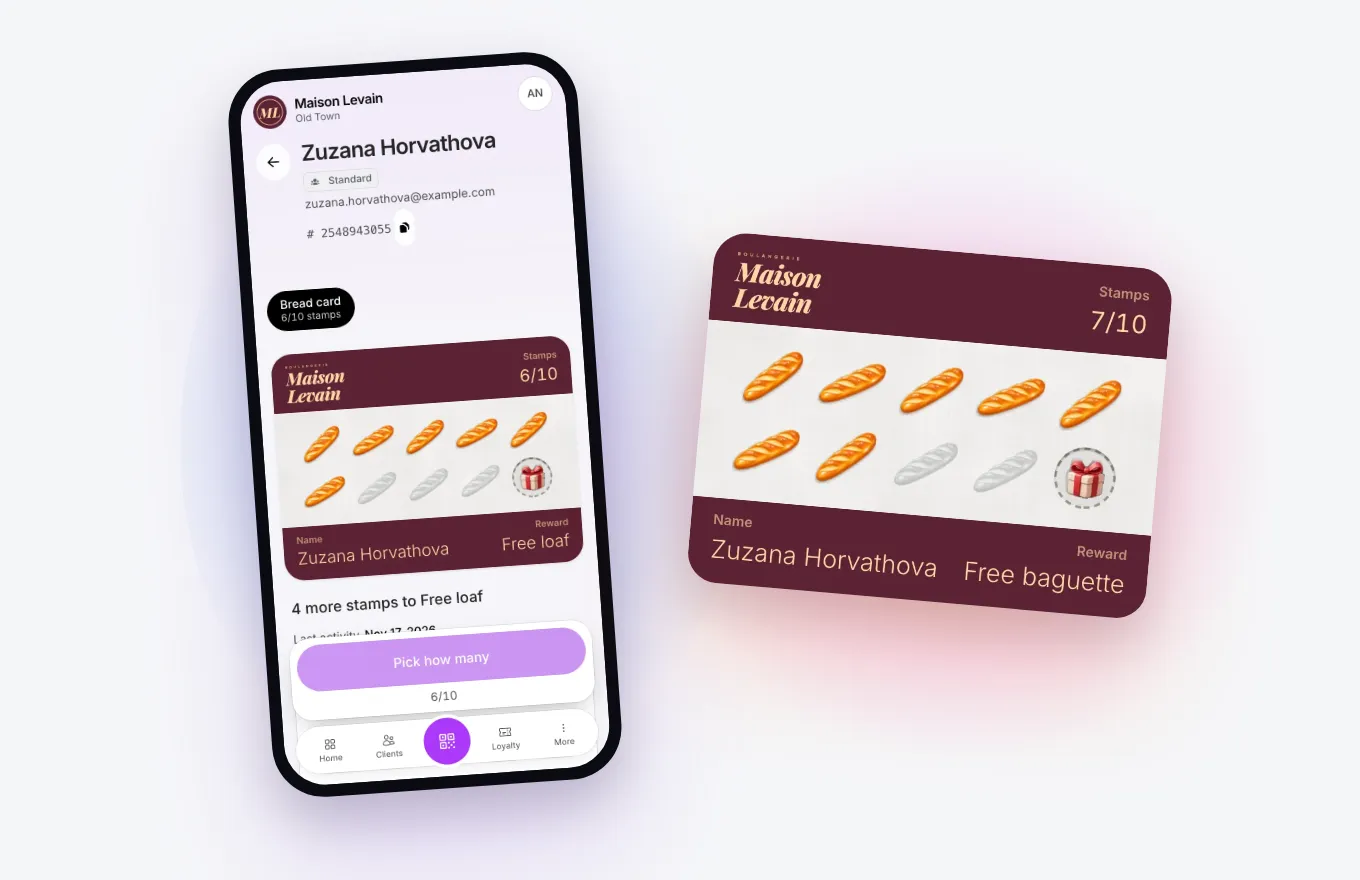
- Recognise them when they come back. By name if the screen shows it, with a smile if not. The visit after the win-back is the one that rebuilds the habit, the same way the second visit turns a newcomer into a regular.
- Then stop. One message, at most one gentle reminder a week later. Three "we miss you" messages in a month start to read like letters from a debt collector, and the people who have moved away have every right to be left alone.
This is the part of running a shop we built Loyalius to take off your plate. Loyalius, a loyalty platform that puts stamp, points and cashback cards in Apple Wallet and Google Wallet, keeps the quiet list for you and can send the win-back message with a free stamp on its own. On the Growth plan it also shows whether the message worked against a held-back group, and it counts someone as "came back" only if they visit within 14 days.
What bakery owners ask about lost regulars
Should I offer a discount to win back lost customers?
A small, specific gift works better than a percentage off. A free pastry or a free stamp says "we missed you" and costs little, while a discount teaches people to wait for the next one.
What should a win-back message say?
Name the shop, say you have missed them, and give one reason to come by with a date on it. Two short sentences are enough. Leave out guilt and long offers.
Is it worth contacting a customer who left after a complaint?
Yes, if you can say what you changed. A message that says the queue is shorter because there is now a second person on the till from 7:00 is worth more than any free croissant. If nothing has changed, fix that first and write afterwards.
Who did you last see in September?
Tomorrow at opening, ask whoever works the early shift to name five regulars they have not seen for a while. Write the names on the back of the rota. My guess is that at least two of them would walk in again next week if someone simply let them know they were missed. Which two are they?
More stories
 Should you close your restaurant on slow days? Do this sum first
Quiet Mondays? Work out what the day really earns, how many guests would beat closing it, and how to fill it if it is worth keeping. A bistro example.
 How to get staff to upsell when they hate sounding pushy
Staff never recommend anything? Give them one product, one sentence and one moment at the till each week, then count. A bakery example with the sums.
 How to get more clients as a nail tech when your book still has gaps
One nail tech's week is filled by about 60 regulars, not thousands of followers. Here is the sum, and five steps to find and keep them.