
Restaurant loyalty program ideas: one points setup and a weekly routine to run it
 Oleksii Andriiuk
Founder
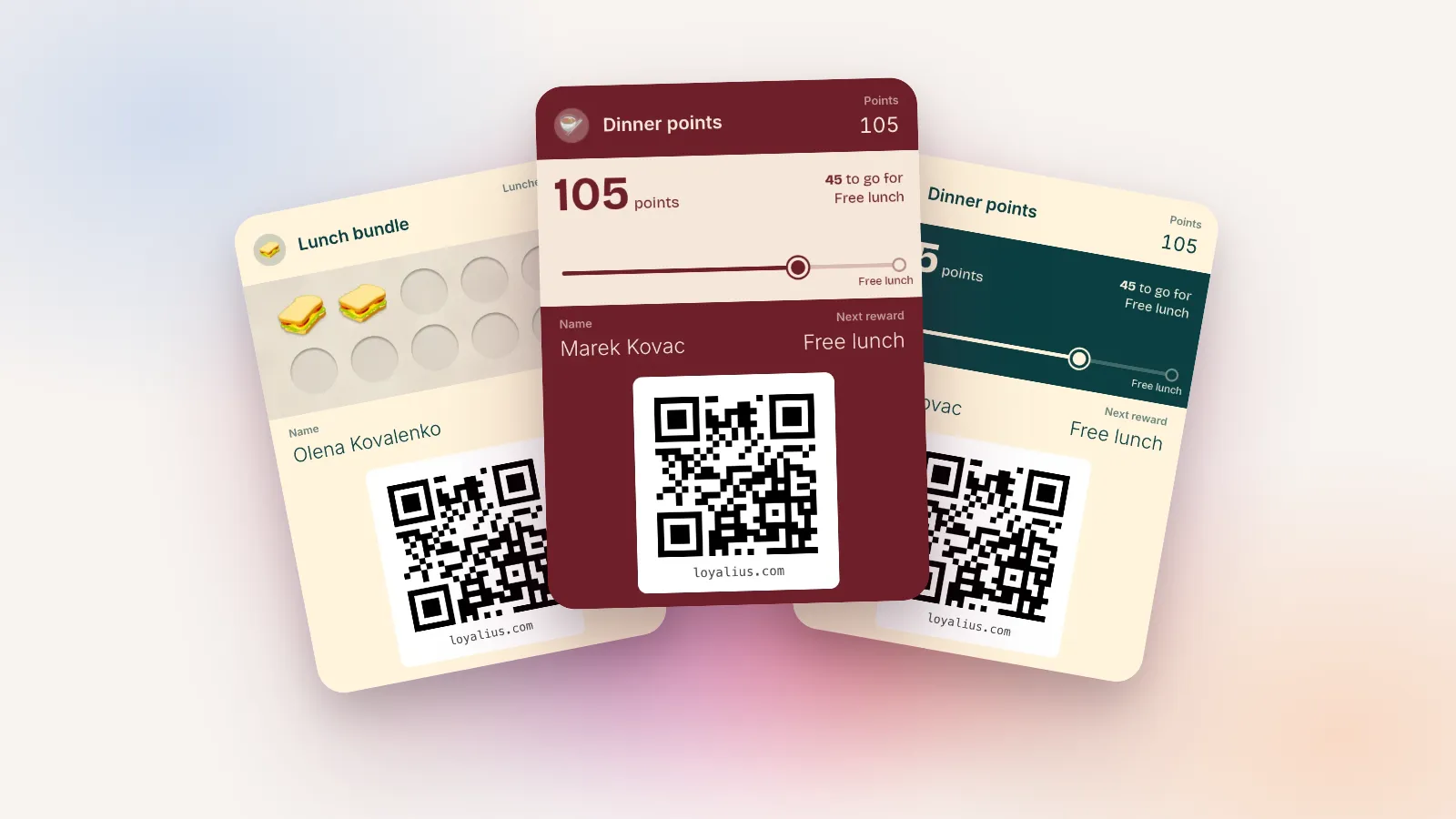
The restaurant loyalty program idea that works for most small restaurants is a points card in the guest's phone: one point per euro on food, a free dessert or coffee at 60 points and a free lunch at 150. Add a prepaid lunch bundle for weekday regulars and fifteen minutes a week to look at the numbers, and the programme mostly runs itself. Below is the setup to copy, what it costs you, and the weekly routine that keeps it alive.
I read the top results for "restaurant loyalty program ideas" this morning. Nearly all of them are lists of seven to ten programme types, illustrated with American chains, and not one tells you what to do on a Monday. A small restaurant does not need seven types. It needs one card that suits how people eat with you, and a habit that takes less time than counting the float.
The restaurant loyalty program setup to copy
A restaurant loyalty program is a way of giving guests a small reward for coming back, recorded on a card they carry, so the regulars you already have visit a little more often. Here is the version I'd start with in a restaurant that does lunch and dinner. You can see how the card itself looks on our restaurant page.
| Setting | My pick | Why |
|---|---|---|
| Card type | Points | A 13 € lunch and a 70 € dinner for two should not earn the same |
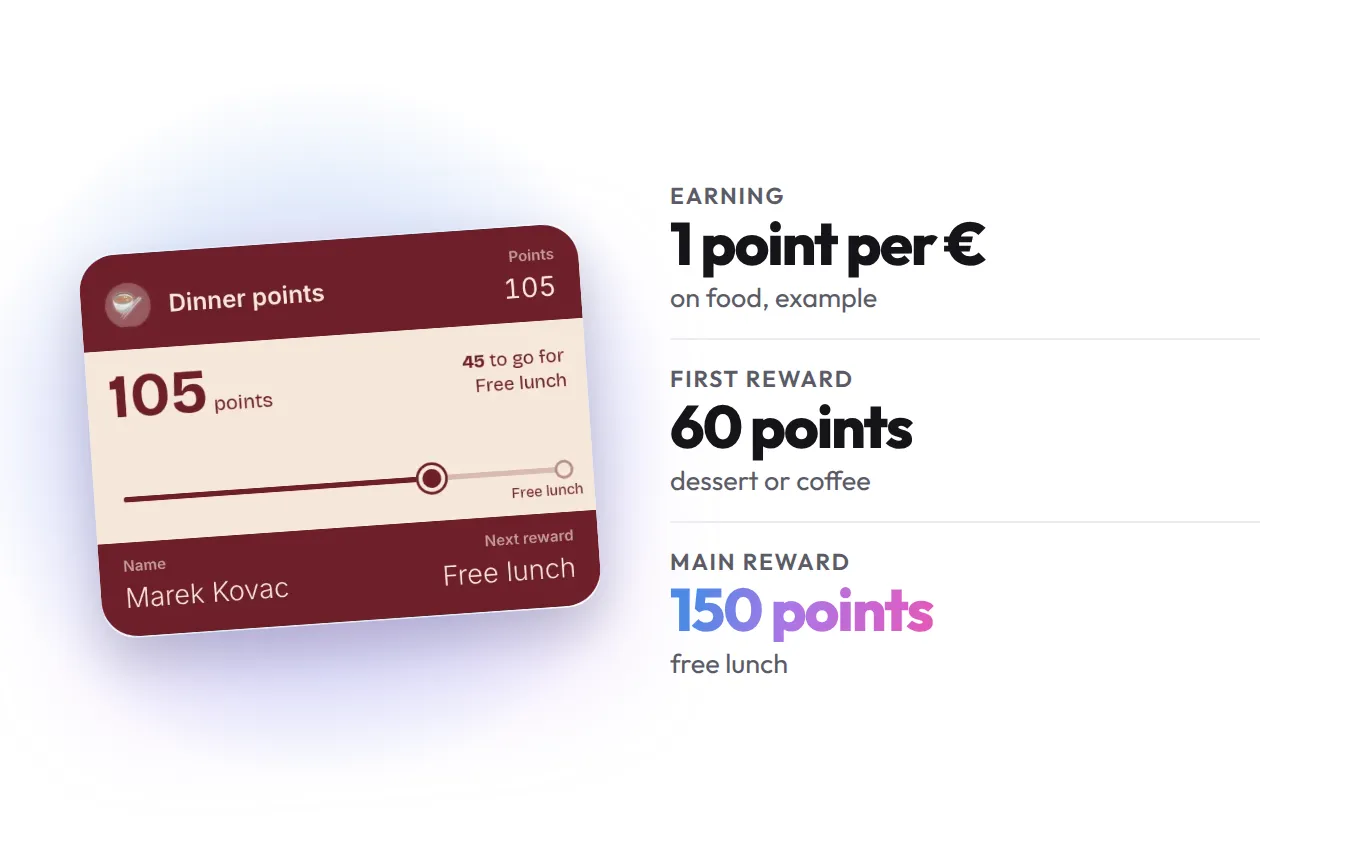
| Earning | 1 point per euro, on food | Easy for guests to follow, easy for staff to explain |
| First reward | Dessert or coffee at 60 points | Reachable in four or five lunches |
| Main reward | Free lunch at 150 points | Worth saving for, cheap at cost |
| Birthday | Dessert on the house in their birthday week | Brings people in with company |
| Lunch regulars | 10 lunches paid upfront, priced as 9 | Money now, and a reason to come every weekday |
| Win-back | One message after six weeks away | The only nudge most guests need |
Why points and not a stamp card?
Because restaurant bills vary too much for stamps. A stamp per visit treats a solo espresso and a table of six the same, so either the light lunch guest gets rewarded too fast or the big table feels short-changed. Points follow the bill. If you want the longer version, I compared both in points vs stamps.
Should alcohol earn points?
My answer: no, if your till can leave it out, and yes, if staff type the amount by hand. A bottle of wine on a dinner for four can double the points and bring the reward forward by weeks, which is generous in a way you did not plan. But if a waiter has to subtract the drinks in their head on a full Saturday, the rule costs more than it saves, so keep it simple and give points on the whole bill. With Loyalius, a loyalty platform that puts stamp, points and cashback cards in Apple Wallet and Google Wallet, leaving a category out of earning is a product rule, and those come with the Pro plan as of November 2026 (see pricing).
What does a restaurant loyalty reward cost?
A free lunch at 150 points costs you the ingredients of one lunch, not its menu price. Take an example lunch regular who comes twice a week and spends 13 € each time. That is 26 € a week, so they reach 150 points in about six weeks.
| Example lunch regular | |
|---|---|
| Spend per visit | 13 € |
| Visits per week | 2 |
| Weeks to 150 points | about 6 |
| Spent before the free lunch | about 156 € |
| Free lunch at menu price | 13 € (about 8 % back) |
| Free lunch at 30 % food cost | about 3.90 € (about 2.5 % of what they spent) |
These are example numbers; put in your own average bill and food cost. The point stands either way: a reward only goes to people who already came back six times, while a discount goes to everyone who walks in. I went through the full calculation for stamp cards in what a loyalty reward really costs, and the same logic works for points.
The dinner guest who comes once a month for 70 € will take two months to reach the free lunch. That is fine. For them the card is less about the reward and more about you being on their lock screen when they decide where to eat on Friday.
The weekly routine
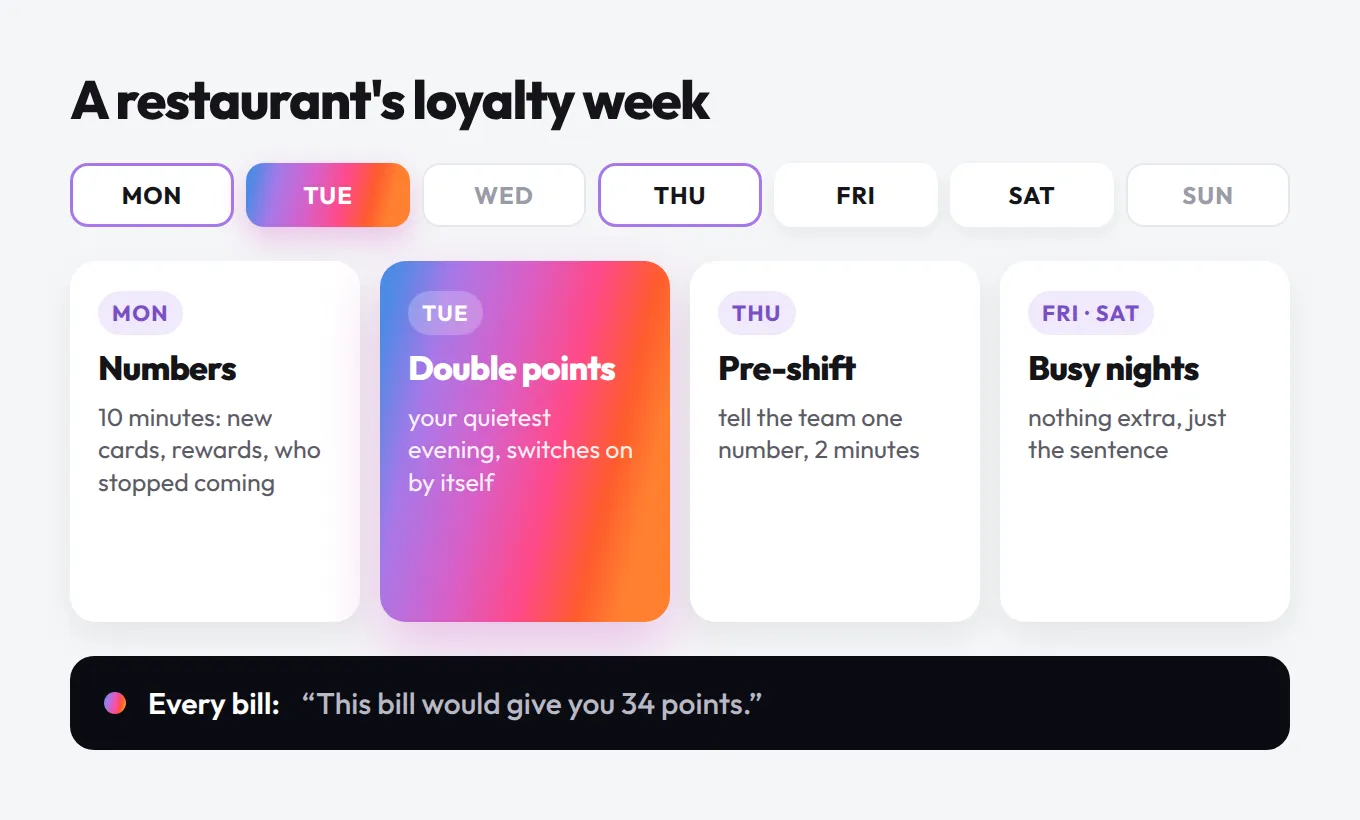
Most restaurant loyalty programmes do not fail at launch. They fade in month three, when nobody mentions the card any more. The routine below takes about fifteen minutes of the owner's week, plus one sentence from staff at every bill.
| When | What | Time |
|---|---|---|
| Every bill | One sentence about the card | 5 seconds |
| Monday | Look at last week's numbers | 10 minutes |
| Your quietest evening | Double points, switched on automatically | 0 minutes |
| Pre-shift meeting, once a week | Tell the team one number | 2 minutes |
| Friday and Saturday | Nothing extra, just the sentence | 0 minutes |
| First Monday of the month | Change one thing, or nothing | 5 minutes |
Every bill: one sentence
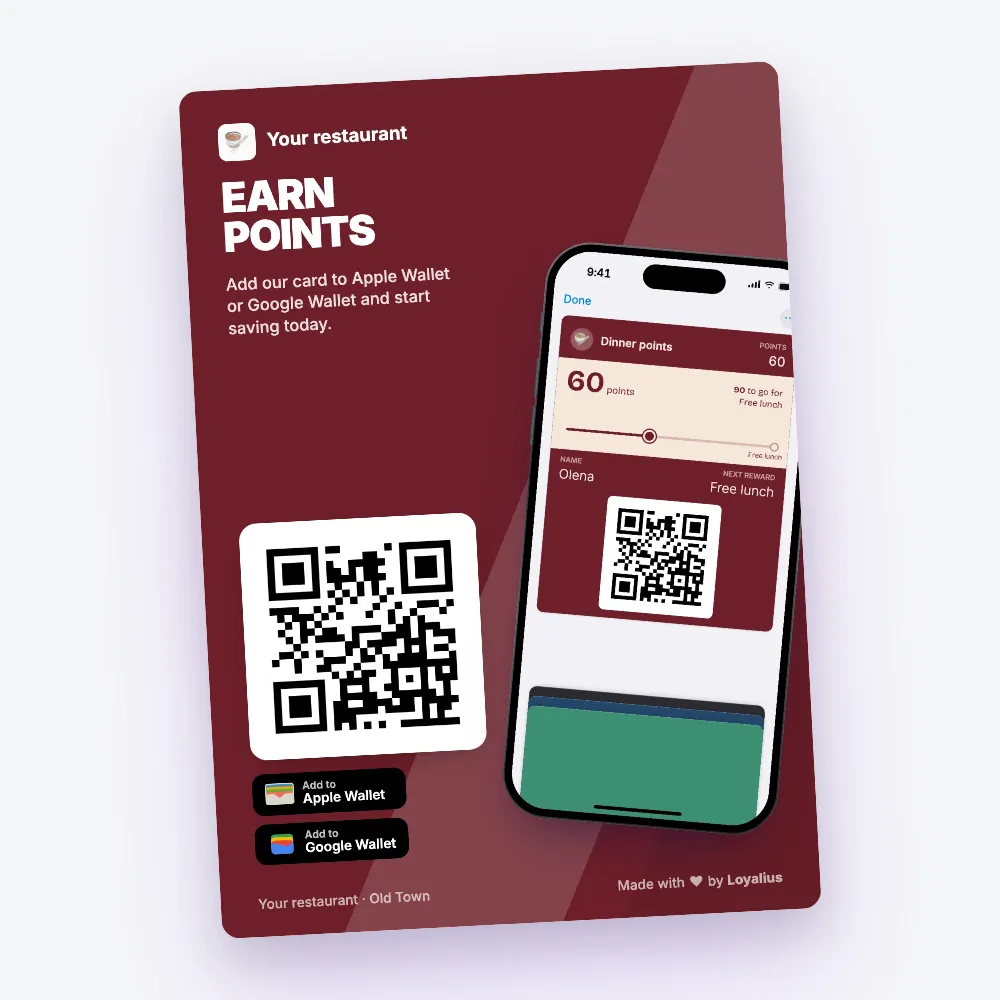
The moment to offer the card is when the bill arrives, not when the menu does. The guest is already holding their phone to pay. "Do you have our card? This bill would give you 34 points" works better than any poster, because it names a real number. Put the QR poster at the door and the counter stand by the till, and the guest can join in the time it takes the card machine to connect. If guests still are not joining, the fix is usually the ask at the till, not the reward.
Who gets the points when one person pays for a table of four? The person who pays. I would not try to split them. The guest who brings three friends and picks up the bill is the best marketing you have, and a few extra points for them is cheap.
Monday: ten minutes with the numbers
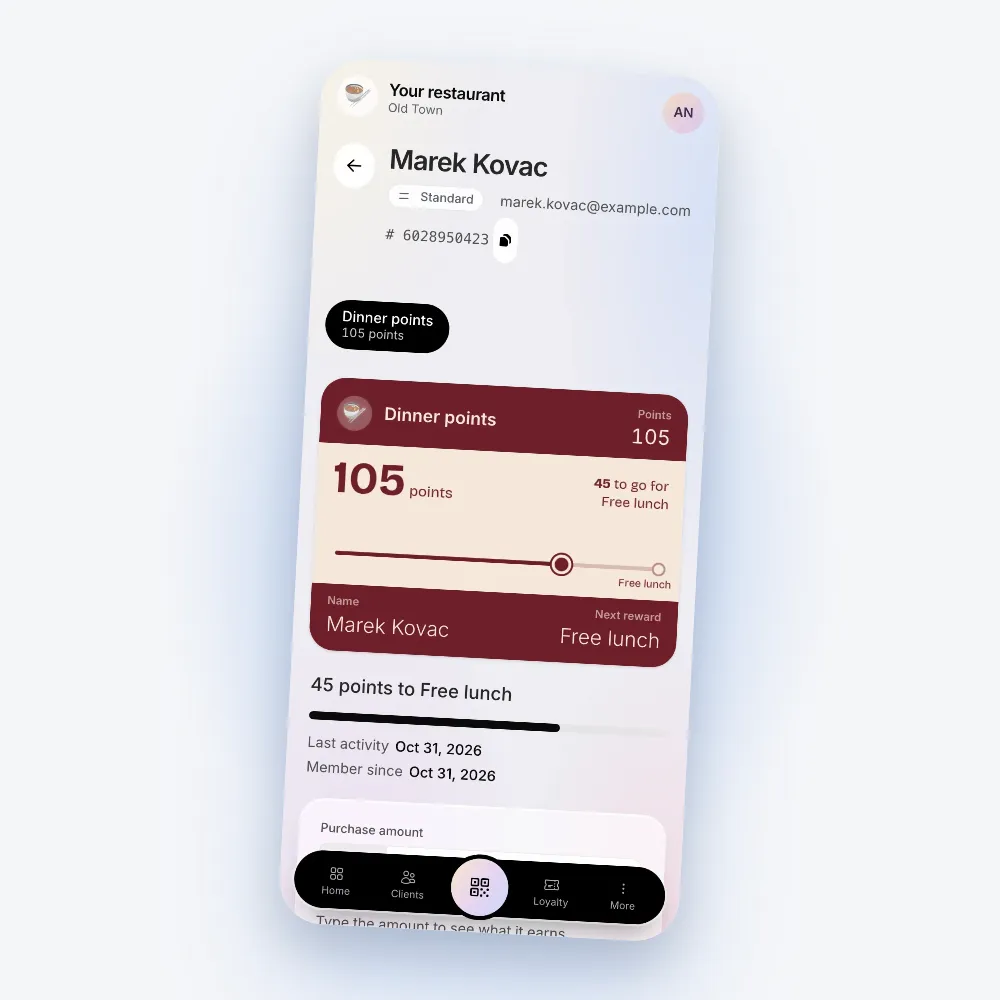
Look at three things: how many new cards joined last week, how many rewards were used, and who has stopped coming. The last one matters most. A regular who came every Tuesday and has not been seen for five weeks did not forget you on purpose, and a win-back message with a free dessert is often all it takes. Messages like that are marketing, so they go only to guests who said yes to receiving them; I wrote about which messages need consent.
Your quietest evening: double points
Every restaurant has an evening that hurts. For many it is Tuesday or Wednesday, and in January it can be most of the week. Double points on that one evening gives regulars a reason to pick it, and it switches itself on and off (earning boosts like this are part of the Pro plan). Leave it running for four weeks before you judge it; one wet Tuesday tells you nothing.
Pre-shift: one number
Once a week, at the briefing before service, tell the team how many cards joined last week. Not as a contest with prizes, just as a fact. Staff who hear the number every week keep saying the sentence. Staff who never hear it stop by February.
Lunch regulars: sell the bundle
The office crowd who eat with you three times a week are your most predictable guests. A prepaid bundle of ten lunches priced as nine puts money in the till before the lunches are eaten, and the card shows how many are left, so there is nothing to track on paper. Bundles are part of the Growth plan.
The checklist
- A points card at 1 point per euro, with a dessert or coffee at 60 and a free lunch at 150
- A decision on drinks: left out by the till, or in when staff type the amount
- The poster at the door and the counter stand by the till
- One sentence everyone says when the bill arrives
- A birthday dessert and a six-week win-back message switched on
- Double points on your quietest evening
- Ten minutes in the diary every Monday
Asked by restaurant owners
Is a loyalty program worth it for a small restaurant?
For most small restaurants, yes, if a good share of guests come more than once a month. The reward costs you a few percent of what regulars spend, and the card keeps your name in their phone. If nearly all your guests are tourists who come once, put the effort into reviews instead.
Should guests earn points on delivery app orders?
Points go on the card when staff scan it or the till sends the bill, so marketplace orders that never pass your till earn nothing. That is not a bad thing. Giving points on takeaway that guests collect at your counter gives them one more reason to order from you directly.
How do I stop staff giving points to their friends?
The cleanest way is a till connection, so points come straight from the bill and nobody types an amount. Without one, compare the points given each day with the day's takings on Monday. A big gap shows up quickly, and in most teams just knowing someone looks is enough.
Does a loyalty card work for a restaurant guests visit once a month?
It works, but slower. A monthly guest takes a couple of months to reach a 150-point reward, so the birthday treat and the occasional message do more of the work. Do not lower the reward to speed it up for them; your weekly regulars would then get a free lunch every few weeks.
Start with the evening that hurts
If you only do one thing from this post this week, pick your quietest evening and give it a reason to exist. The card, the poster and the sentence at the bill are there to make that one evening fuller, and once it is, the rest of the week tends to follow. Look at that evening's covers on four Mondays from now and you will know whether the programme is working better than any report could tell you.
More stories
 Regular customers stopped coming? How to spot it early and win them back
Lost regulars rarely leave in anger. How to see who has gone quiet, why they drift away, and how to bring them back with one small reason and a date.
 Should you close your restaurant on slow days? Do this sum first
Quiet Mondays? Work out what the day really earns, how many guests would beat closing it, and how to fill it if it is worth keeping. A bistro example.
 How to get staff to upsell when they hate sounding pushy
Staff never recommend anything? Give them one product, one sentence and one moment at the till each week, then count. A bakery example with the sums.