
Roadworks outside your shop? How to keep your regulars until the street reopens
 Oleksii Andriiuk
Founder
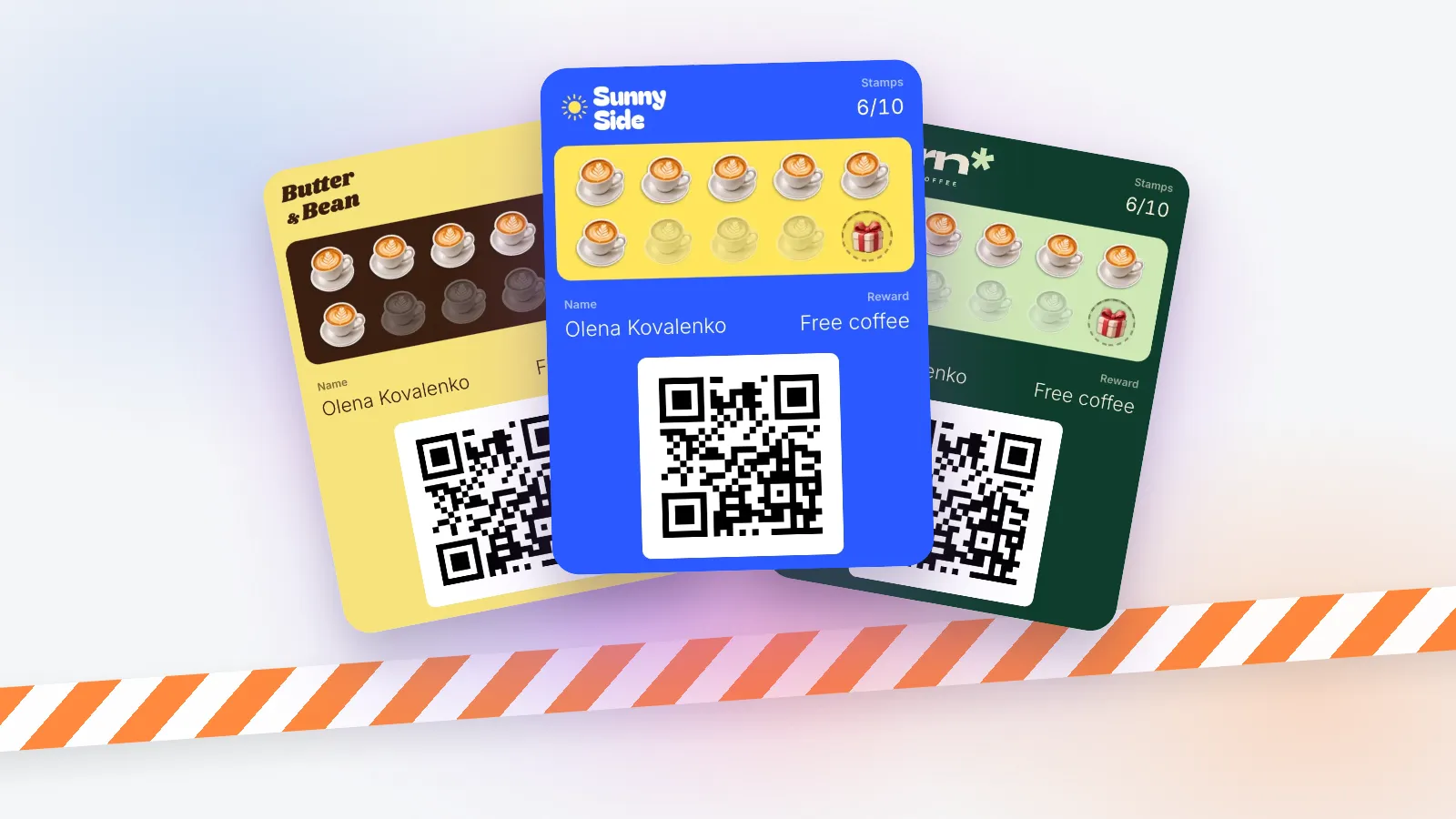
Roadworks outside your shop take away the people who were only passing by, and they can scare off your regulars too, if nobody tells them you are still open and how to get in. The fix is to treat the months of digging as a regulars' season: tell every regular before the fences go up, keep the way in obvious, give them a small reason to make the detour, and cut costs to the smaller crowd. You will not keep every sale, but you can keep the customers who matter most for the day the street reopens.
Nobody asks a café owner whether this is a good year to dig up the pavement. A letter arrives, and from then on the shop is behind a fence for six months or more. What you decide in the first two weeks decides how much of your trade is still there when the fence comes down.
How much do roadworks outside a shop cost in sales?
Roadworks right outside a small shop often cost a third of its sales or more. In a survey by the IHK Würzburg-Schweinfurt chamber of commerce among shops and restaurants next to street works, 45 % of businesses within 50 metres of the site reported a sales drop of more than 30 %, and another 43 % lost 11 to 30 % (IHK Würzburg-Schweinfurt, March 2016). In the same survey, 40 % of the works lasted more than a year.
The loss is not spread evenly across your customers, and that is the useful part. Passers-by disappear first: they take another street, or the café on the corner looks easier to reach. Regulars mostly stay, as long as they know you are open. In 2023 a coffee shop in Stafford, England reported that its sales had halved a few weeks into roadworks, while its regulars kept coming; after the owner posted about it, the place was busier than it had been in a long time (Express & Star, October 2023).
So the question is not how to replace the passing trade, which you mostly cannot. It is how to stop your regulars drifting off with it.
A worked example: one café behind a fence
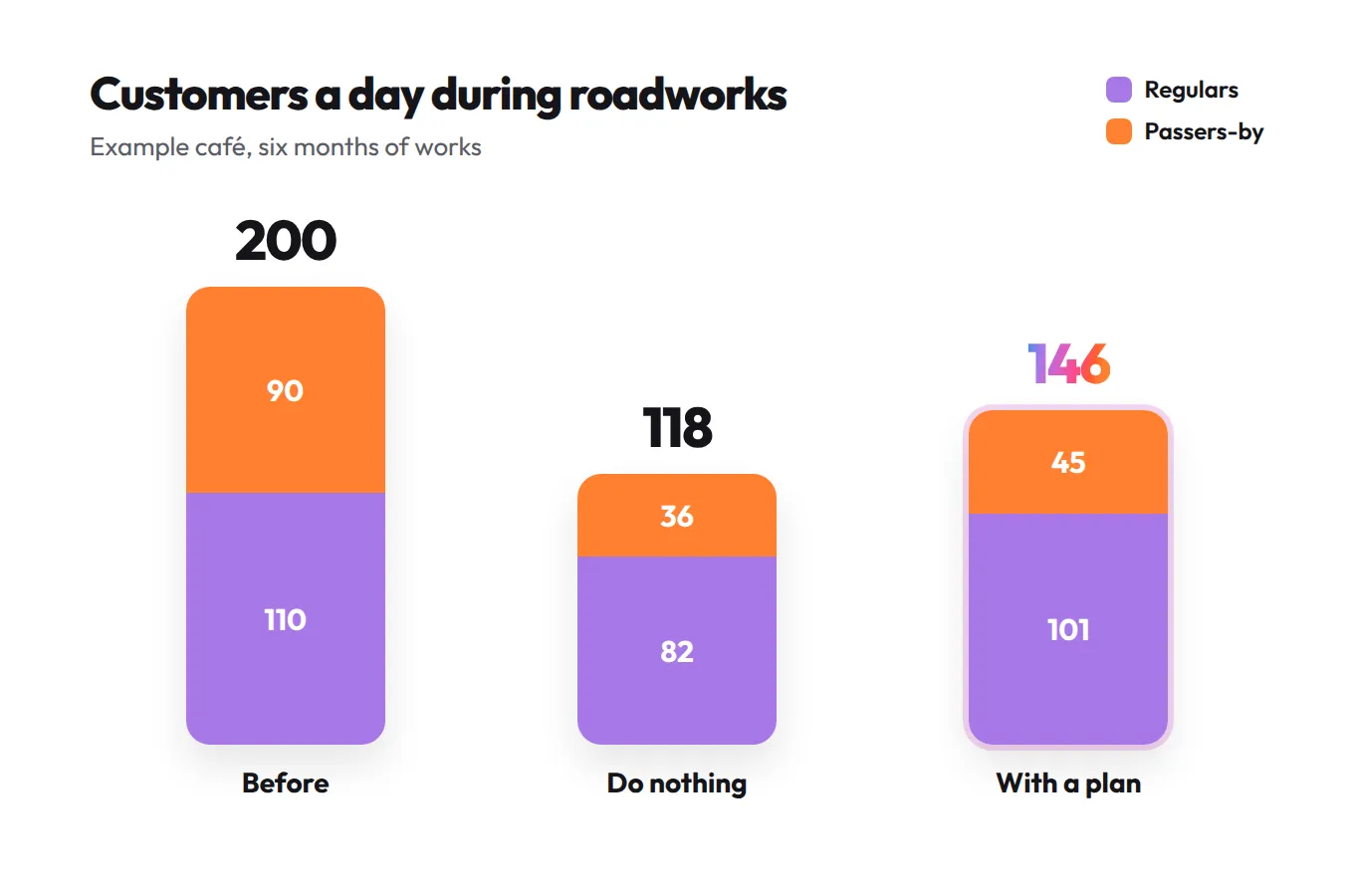
Take a café on a side street, call it Café Lipa, open six days a week. On a normal day it serves 200 customers with an average ticket of 4.80 €: about 110 regulars who come at least once a week, and 90 people passing by. Then the street is dug up for six months. These are example numbers, with the drop sized to match the survey above.
If the owner does nothing, assume a quarter of the regulars drift away (they think the café is closed, or the detour is annoying) and six in ten passers-by vanish. With a plan, the café loses fewer than one in ten regulars and half of the passers-by, because the signs are better.
| Per month (26 days) | Before | Do nothing | With a plan |
|---|---|---|---|
| Customers a day | 200 | 118 | 146 |
| Sales | 24,960 € | 14,726 € | 18,221 € |
| Gross profit (65 %) | 16,224 € | 9,572 € | 11,844 € |
The plan is worth about 2,270 € of gross profit a month. It costs something too: two stamps instead of one for regulars during the works (about 263 extra free coffees a month at 0.90 € each, so 236 €), a banner and signs for about 250 € once, and a loyalty card subscription of 19 €. Over six months that leaves roughly 11,850 € that would otherwise be gone.
Look at the honest line, though: even with the plan, Café Lipa earns about 4,400 € a month less than before. That is why the cost side matters as much as the customer side. Put your own numbers in the same table.
Before the fences go up: tell your regulars first
Your regulars hear about the works from you, not from the fence. As soon as you know the dates, do three things:
- Ask the council or the building company for the exact phases: which side of the street is closed when, where the footpath will run, and whether access to shop doors stays open during opening hours. German chambers of commerce also advise asking for one named contact person.
- Tell every regular in person for two weeks: "From the 3rd they dig up the street. We stay open, the way in will be from the courtyard." Say it at the till, not only on a poster.
- Get a way to reach them that does not depend on them walking past. A phone number on a list, an email, or a loyalty card in their Wallet that can show a message. This is the one week when it is easy to ask, because the reason is obvious.
If you have a card in Apple Wallet or Google Wallet, a short message reaches the lock screen of everyone who holds it, which is exactly what you need when the street itself is shouting "closed". Loyalius, a loyalty platform that puts stamp, points and cashback cards in Apple Wallet and Google Wallet, works this way (here is our loyalty card for coffee shops), and how a Wallet card works explains the steps from the QR poster to the message. Promotional messages need the customer's consent, so ask for it when they join; which messages need consent under GDPR goes through it.
While they dig: make the detour worth it
Once the fences are up, three things keep people coming.
A way in that nobody can miss. Signs at both ends of the street, not only at your door, with an arrow and the words "open as usual". A sign 200 metres away catches the person deciding whether to turn into your street at all. I would spend the first few hundred euros here before a single euro on adverts: people see that sign hundreds of times a week for free. In Erlangen, shops laid red carpets across the site to their doors during works in 2013, and customers liked it (IHK Nürnberg guide, 2015). It sounds silly until you picture it.
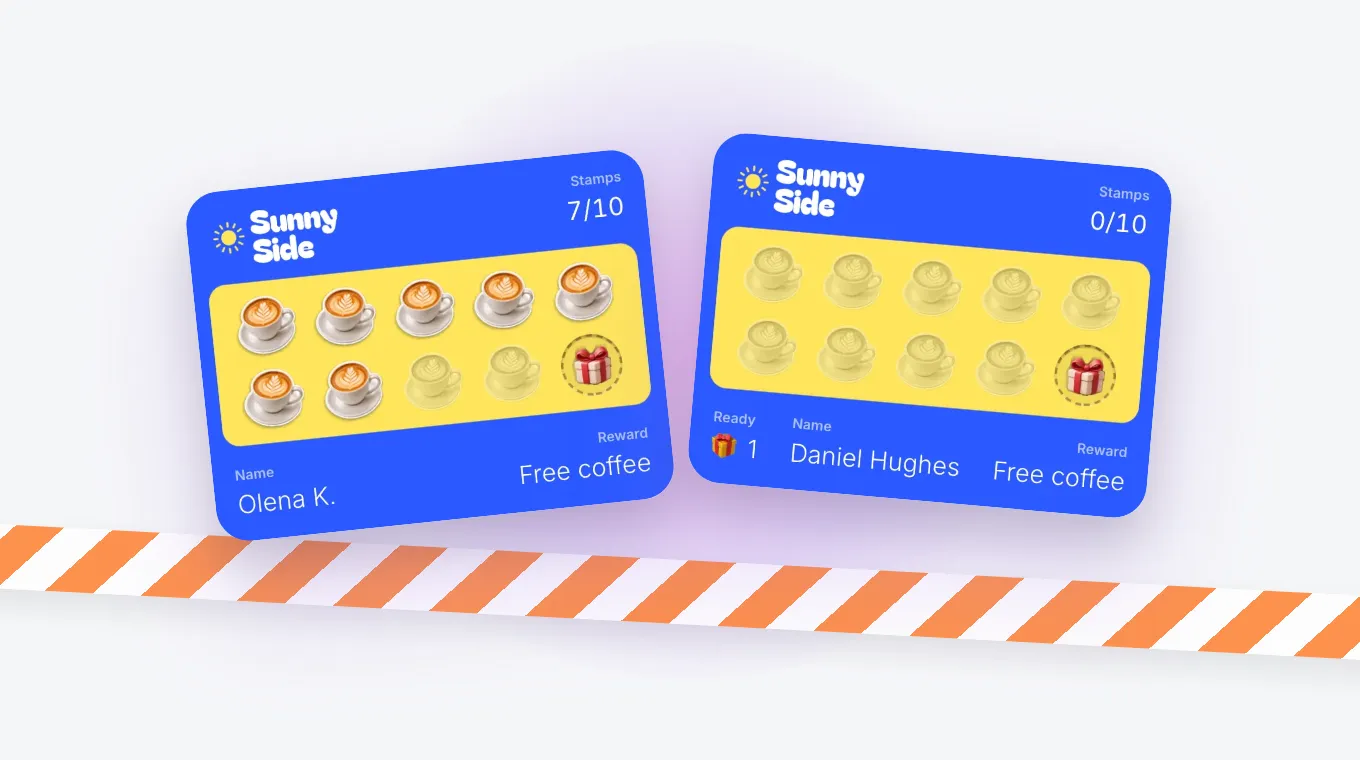
A small thank-you for the detour. Two stamps per visit instead of one for as long as the works last, or a free pastry on the tenth coffee. Keep it for the people who make the effort, not a discount on the board for everyone. A regular at seven of ten stamps walks around a fence for a free coffee; a stranger does not walk around it for 10 % off.
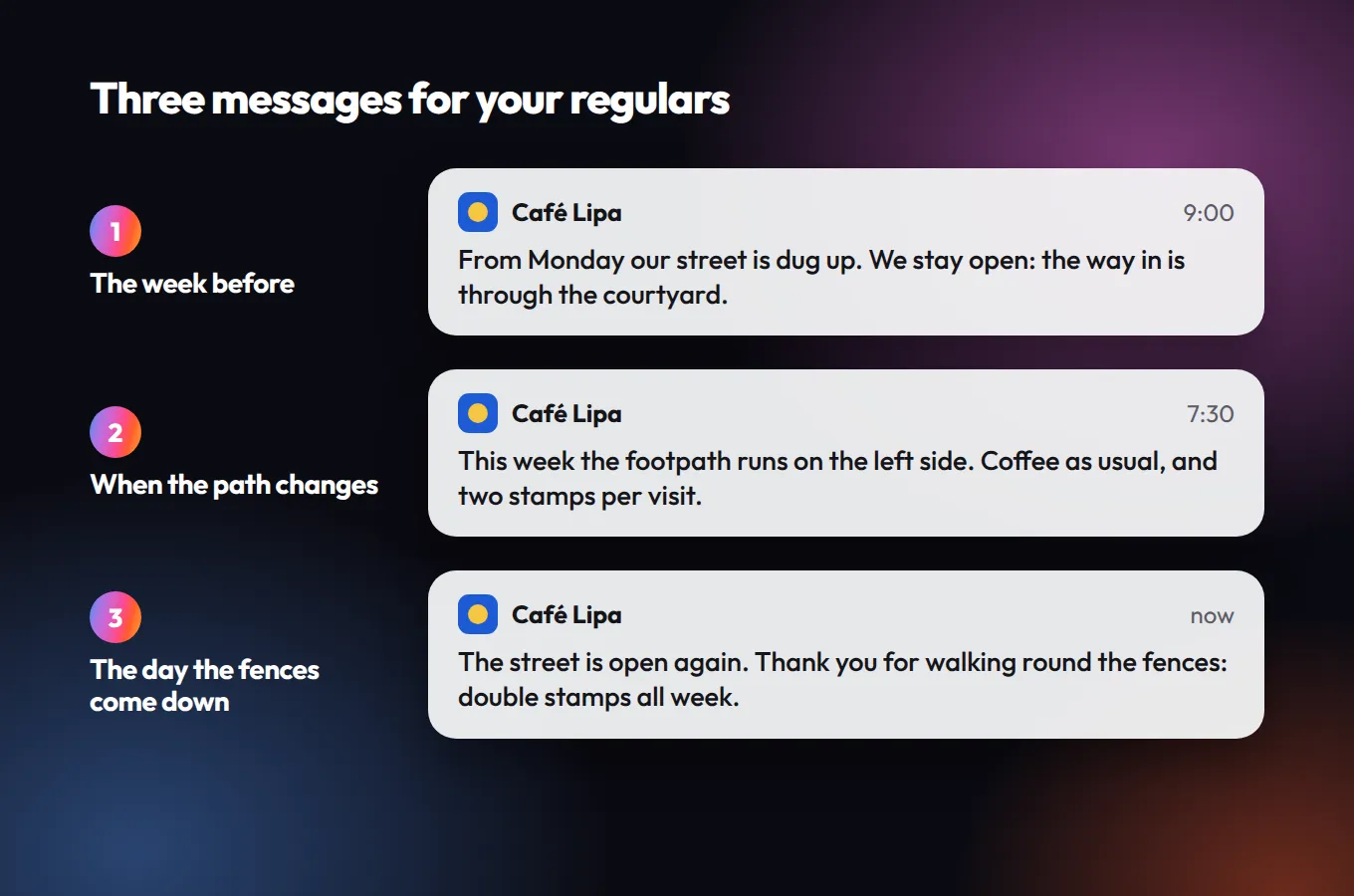
A message at the moments that matter. Not every day. One the week before, a short one when the way in changes, and one when it is over. Each says where to walk and that coffee is on as usual.
Cut costs to the street you have now
The smaller crowd needs fewer hours and less stock. Look at your till each week and plan staff for the customers you actually have, not the ones from last spring. If the street is quiet after 3 pm, closing an hour earlier while the works last is a sensible choice, not a defeat; tell your regulars, and put it on the sign.
Talk to your neighbours as well. Shops on one street can share signs and ask the council for things together. The chambers of commerce in Germany call this construction-site marketing, and their guides keep coming back to the same step: one group, one contact person, one message.
Questions owners ask about roadworks
Can I get compensation for roadworks outside my shop?
Sometimes, but rarely, and it depends on the country and the city. In Germany, the IHK Braunschweig explains that shops usually have to accept lost sales for some weeks and months without payment, and that a claim is possible mainly when access is cut off or the impact is unusually severe or long (IHK Braunschweig, as of November 2026). Some cities offer their own help, such as Kraków's support package for businesses on streets under long works (City of Kraków, February 2025), so ask your town hall and chamber of commerce what applies to you.
Should I close my shop while the street is dug up?
Usually not completely. Regulars who find you closed for a month learn to go somewhere else, and that habit can outlast the works. Shorter hours on the quietest days are often the better trade.
How early should I tell customers about roadworks?
As soon as you know the dates, and again the week before. Two weeks of telling people at the till is enough for most regulars to hear it at least twice.
The day the fences come down
The end of the works is your best day in months, and most shops waste it by simply reopening the pavement. I would plan it like an opening: a message to every regular, the double stamps for one more week as a thank-you, and the people who came through the mud greeted by name. If you know your street is next on the council's list, the week to start collecting phone numbers and cards is this one, not the one when the letter arrives. And when regulars do drift off anyway, winning back customers who stopped coming shows how to find them again.
More stories
 How to stop no-shows at your barbershop without scaring off new clients
Deposits stop no-shows but can cost you more in lost bookings. The sums for a three-chair barbershop, and who should really pay up front.
 Opening a second location without emptying the first one
Where the first customers of a new branch come from, six mistakes owners make, and a worked salon example with the sums to break even.
 January slump in retail: a plan for small shops that starts in December
Retail sales fall by up to a fifth after Christmas, and February is even quieter. A dated plan for small shops that starts with December's gift buyers.