
Franchise loyalty program: who pays when a reward is redeemed in another branch?
 Oleksii Andriiuk
Founder
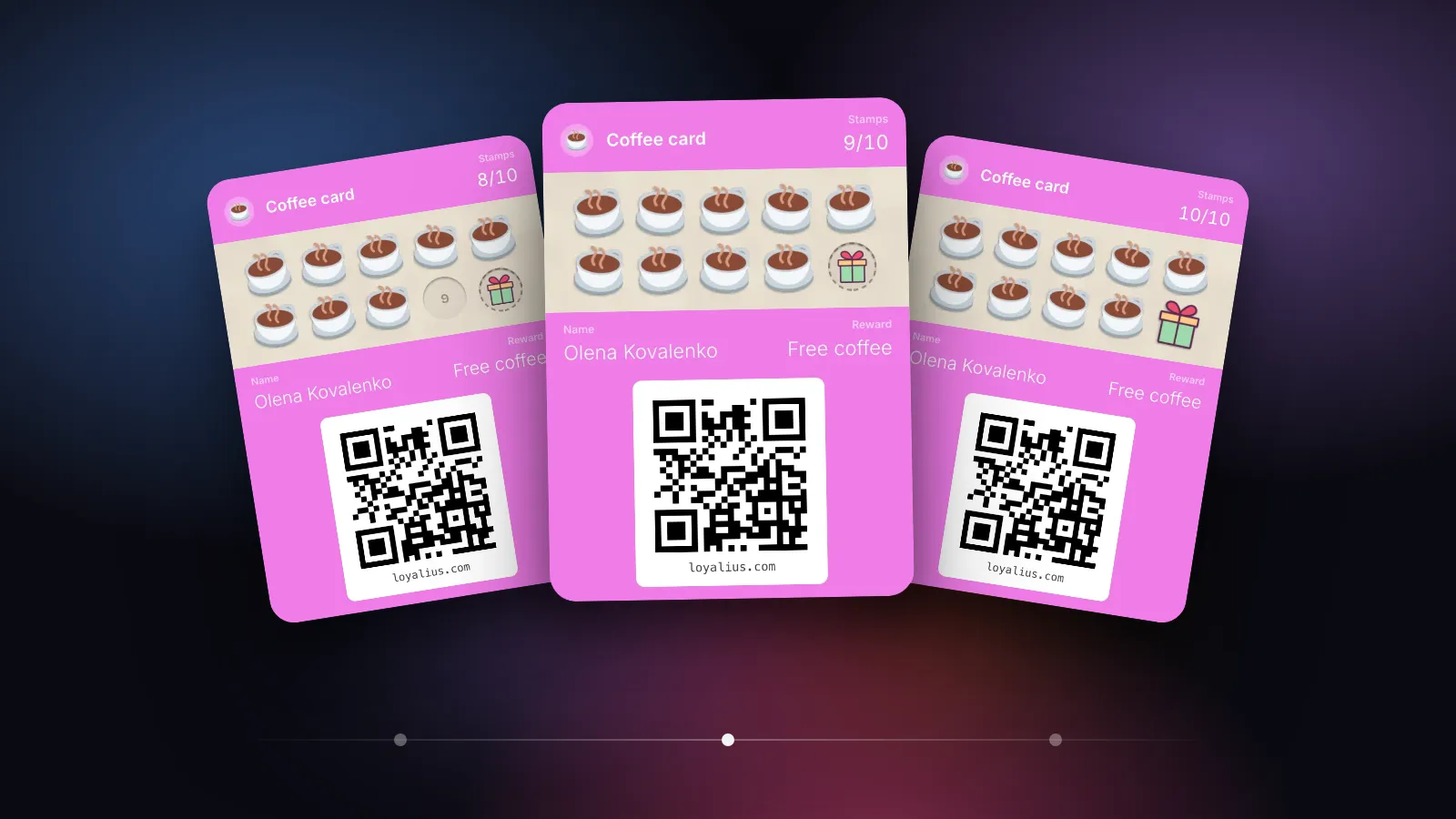
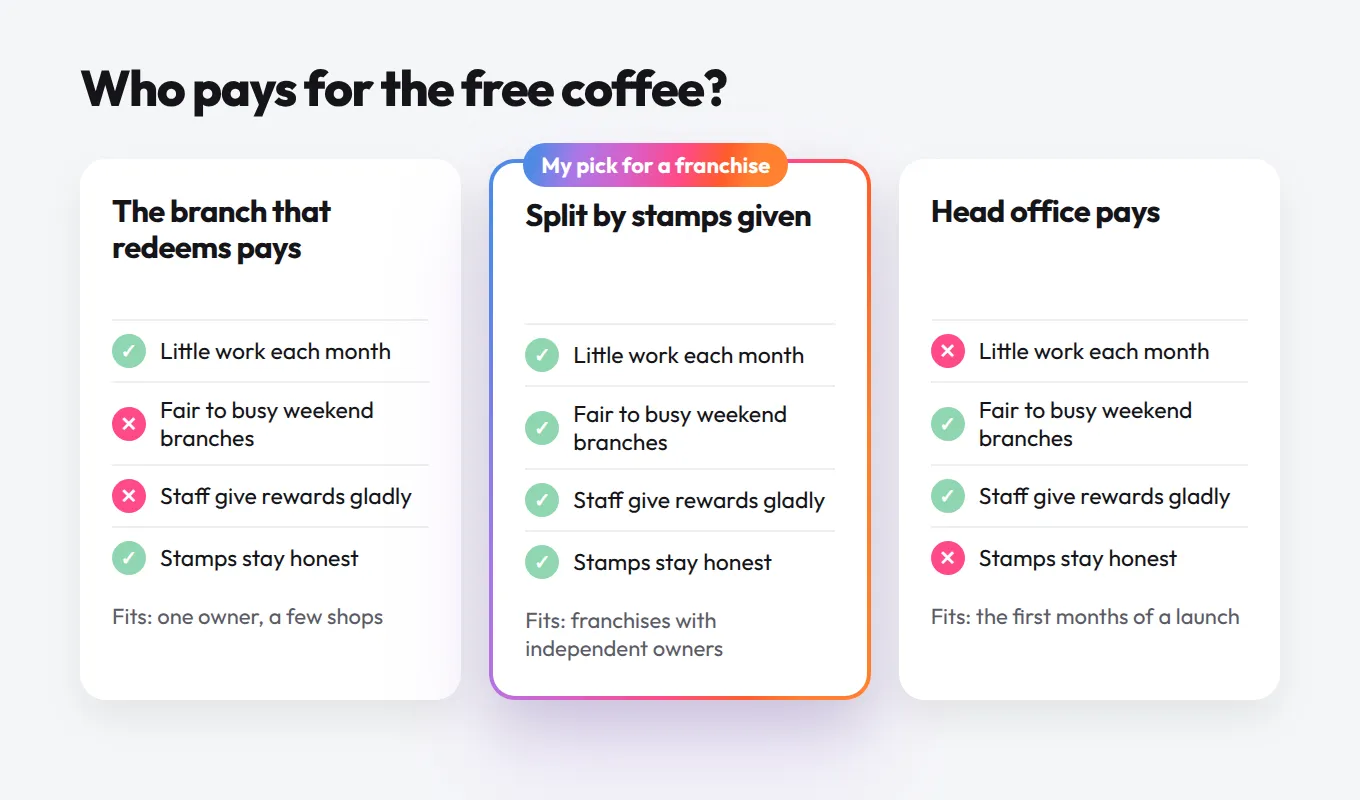
In a franchise loyalty program, the hard question is not the card but the bill: a customer collects stamps in one branch and takes the free coffee in another, and someone has to pay for it. There are three ways to handle it: the branch that gives the reward pays, the cost is split by how many stamps each branch gave out, or head office pays. For most franchises with independent owners I'd split by stamps, settled once a month, because the cost then follows the sales that earned it.
This post is for whoever runs loyalty across a franchise or a chain where branches keep their own books. If every shop belongs to one company and nobody's bonus depends on branch profit, you can stop reading here: the money ends up in the same account either way. For everyone else, this is the conversation to have before the first stamp goes on your Wallet loyalty card, not after the first angry phone call from a franchisee.
The three ways to pay for a franchise loyalty reward
| The branch that redeems pays | Split by stamps given | Head office pays | |
|---|---|---|---|
| How it works | Each branch carries the cost of the rewards it hands over | Each month, the total reward cost is shared by each branch's share of stamps | Head office refunds every reward |
| Work each month | None | One sum and a few transfers | Refunds to every branch |
| Fair to busy weekend branches | No | Yes | Yes |
| Risk at the till | Staff get slow to give rewards | Low | Stamps get handed out freely |
| Fits | One owner, a few shops | Franchises with independent owners | The first months of a launch |
The rule underneath all three is the one from the maths of a stamp card reward: value the reward at cost price, not menu price. A free coffee that sells for 3.40 € might cost the branch 0.90 € in coffee, milk and cup. Agree that one number for the whole network and write it down, or every settlement turns into an argument about what a latte really costs.
Why "the branch that redeems pays" goes wrong
The simplest option fails in a predictable way. Customers don't collect and redeem evenly. They collect on weekday mornings near the office or the station, and they take their reward on Saturday in the old town, when they have time to sit down. So the station branch gives out the stamps and gets the sales, and the old town branch gives out the free coffees.
On paper the old town branch now looks like it is losing money on the card. In practice it is worse than that: a franchisee who feels the card is a tax will, sooner or later, let the team get vague about rewards. "Our machine is down." "Can you use it at the other shop?" One customer told that once may not come back to either branch.
That hesitation at the till is the real cost of the simple option, and it doesn't show up in any report.
How does the stamp split work?
The stamp split shares the cost of every reward handed out in a month by the share of stamps each branch gave out that month. The branch that sold the coffees pays for the free one, wherever it was poured. You need two numbers per branch per month: stamps given and rewards redeemed.
- Add up the rewards redeemed across the network and multiply by the agreed cost price. That is the month's reward cost.
- Work out each branch's share of all stamps given that month.
- Multiply the reward cost by that share. That is what each branch should carry.
- Compare it with what the branch actually gave away at its own till.
- Branches that gave away less than their share pay the difference into a shared account; branches that gave away more get it back.
Here is an example with three branches of a café franchise, a free coffee at 0.90 € cost and one stamp per coffee. The numbers are illustrative.
| Branch | Stamps given | Rewards redeemed | Actual cost | Fair share | Settlement |
|---|---|---|---|---|---|
| Station | 3,000 | 150 | 135 € | 220 € | pays 85 € |
| Old Town | 2,000 | 260 | 234 € | 147 € | receives 87 € |
| Mall | 1,500 | 120 | 108 € | 110 € | pays 2 € |
| Total | 6,500 | 530 | 477 € | 477 € |
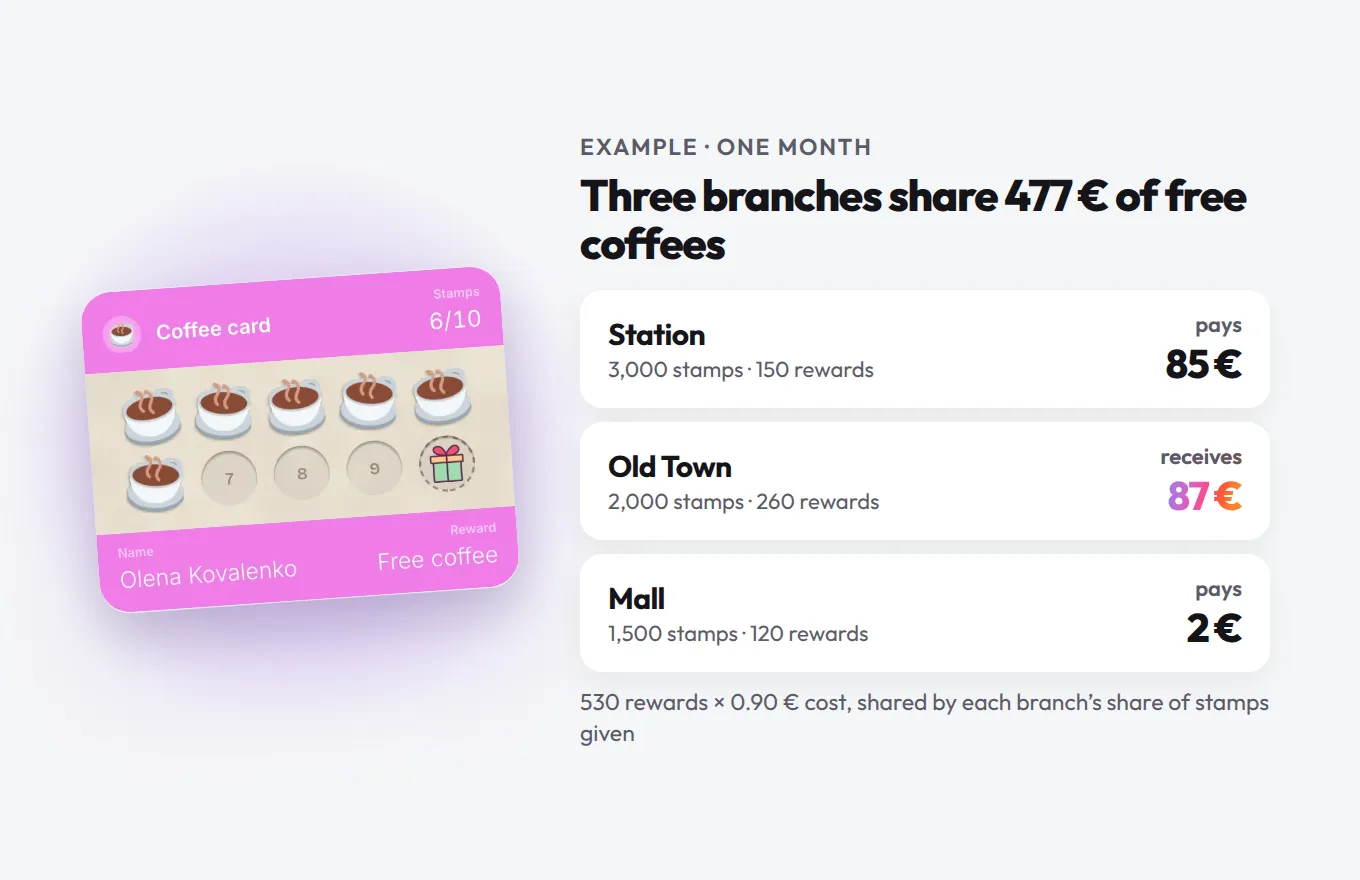
Two transfers and a short table. The whole job takes a few minutes on the first working day of the month, and in a network of 30 branches it is the same five steps, just with a longer column.
I'd settle monthly rather than per reward. Tracking where each of the ten stamps on one card came from sounds precise, but a monthly split gets the same answer over a year with a fraction of the work, and nobody has to explain to a franchisee why one free coffee was split into four pieces.

When head office should pay
Head office paying for everything feels generous, and in the first two or three months it can be the right call. Franchisees are being asked to train staff, hang posters and change a habit at the till; taking the reward cost off their plate is a fair way to get the card going. Say from the start when it ends.
After that, I'd keep one clear rule: whoever decides on an extra pays for it. If head office sends a double-stamps message to the whole network for a slow week in January, head office covers the extra stamps from that week. If one branch runs double stamps on the day of its street festival, that branch covers it. The normal card, one stamp per coffee, goes through the monthly split.
The danger of head office paying forever is quiet. When a free coffee costs a branch nothing, an extra stamp "for a nice customer" costs it nothing too, and some branches start giving stamps away. If that happens, the numbers will show it: a branch whose stamps per 100 sales sits far above the others is worth a visit.
What goes in the franchise agreement
Whatever you choose, put it in writing before launch. While researching this post, I read through franchise disclosure documents from US chains, and one from 2025 says plainly that the franchisor has no obligation to reimburse franchisees for free products given to loyalty members. That is a valid choice, but a franchisee should read it before signing, not discover it in the first busy month.
A one-page loyalty annex can cover it:
- the reward, and the cost price used to value it, reviewed twice a year;
- which of the three payment methods applies, and the settlement date;
- who pays for network-wide campaigns and who pays for local ones;
- whether every branch must accept the card (I'd say yes, a card that works in 18 of 20 shops is a card customers stop trusting);
- what happens to stamps when a branch closes or changes owner;
- who is responsible for customer data. The European Data Protection Board explains that a franchisor and franchisees who decide together how customer data is used can be joint controllers with shared responsibilities under GDPR (as of November 2026).
I'm not a lawyer, and this is not legal or tax advice. Ask yours how unredeemed stamps should be shown in each franchisee's accounts, too.
For the practical side of getting every branch live, there is a separate rollout plan for multiple locations. Loyalius, a loyalty platform that puts stamp, points and cashback cards in Apple Wallet and Google Wallet, shows the cards of every branch in one dashboard, with prices per location and branch roles and reports on the Pro plan.
Questions franchise owners ask
Should a franchise loyalty card work in every location?
Yes. Customers see one brand, not a list of owners, so a card that is refused in one branch damages the card in all of them. Solve the cost question with a settlement rule instead of limiting where the card works.
Can a franchisee opt out of the loyalty program?
That depends on the franchise agreement, so check yours or write the rule into it. I'd make taking part mandatory for every branch and pair it with a fair way to share the cost, because the opt-out branch is the one where customers get turned away.
Do gift cards work the same way across branches?
The problem is similar: the money is taken in one branch and spent in another. The difference is that gift card money was paid by the customer, so the branch that sold it is holding cash that belongs to the branch that serves it. The gift card mistakes to avoid are worth a look before December.
What happens to stamps when a franchise branch closes?
The stamps should stay on the customer's card and keep working in every other branch. Settle the closing branch's share of the reward cost in its final month, and say in the franchise agreement that this is how it works.
Settle it before the first stamp
A loyalty card is supposed to make the till a friendlier place, and in a franchise it only does that if no one behind the counter is doing sums in their head before handing over a free coffee. So before you print a single poster, take the three columns at the top of this post to your next franchisee meeting and pick one. Most of the arguments about loyalty in a franchise come later, from that decision being left open.
More stories
 Regular customers stopped coming? How to spot it early and win them back
Lost regulars rarely leave in anger. How to see who has gone quiet, why they drift away, and how to bring them back with one small reason and a date.
 Should you close your restaurant on slow days? Do this sum first
Quiet Mondays? Work out what the day really earns, how many guests would beat closing it, and how to fill it if it is worth keeping. A bistro example.
 How to get staff to upsell when they hate sounding pushy
Staff never recommend anything? Give them one product, one sentence and one moment at the till each week, then count. A bakery example with the sums.